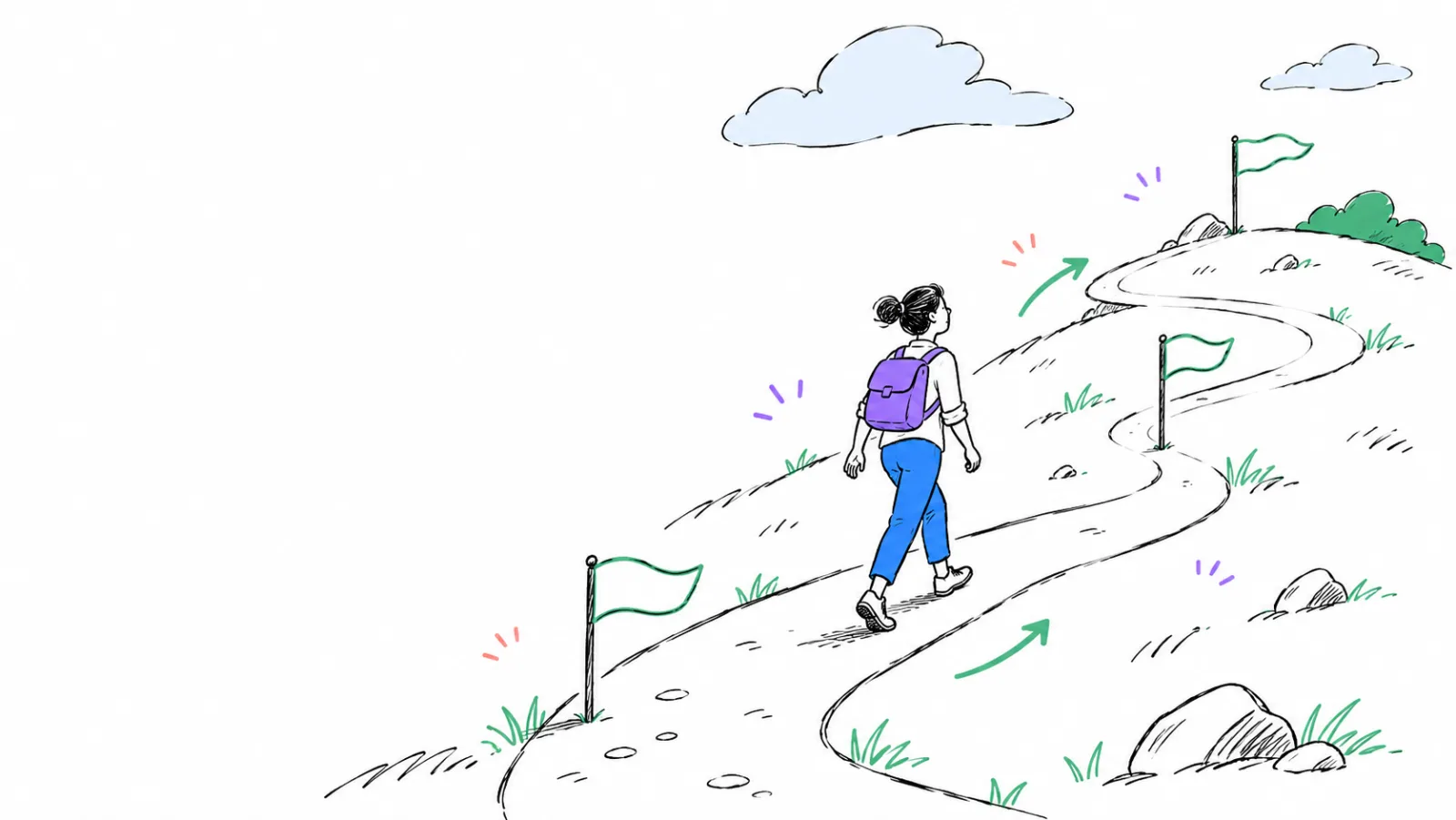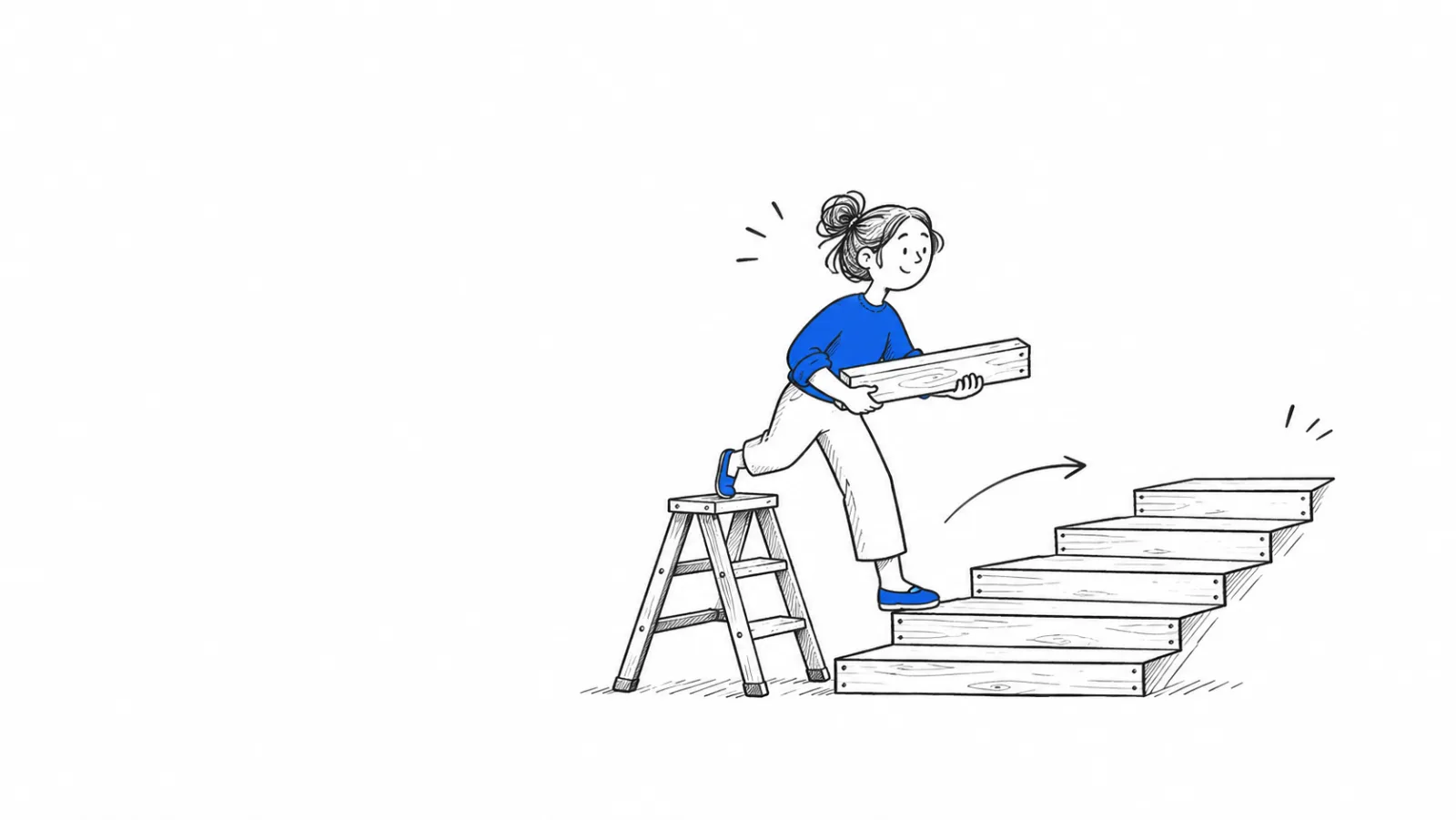
Intrinsic vs extrinsic motivation comes down to why you do something. Intrinsic motivation means doing an activity because it is satisfying in itself, such as studying a subject you find genuinely interesting. Extrinsic motivation means doing it for a separate outcome, such as pay, course credit, approval or avoiding a penalty. That two-way split hides a lot. In self-determination theory, extrinsic motivation is a range of types, and some of them feel almost as self-chosen as interest does. Research at work often draws the line between autonomous motivation, the reasons you endorse, and controlled motivation, the reasons you feel pushed by.
What is the difference between intrinsic and extrinsic motivation?
Ryan and Deci define intrinsic motivation as doing an activity “for its inherent satisfactions rather than for some separable consequence”. Extrinsic motivation applies “whenever an activity is done in order to attain some separable outcome”. The APA Dictionary of Psychology puts it in plainer terms: intrinsic motivation “derives from pleasure in the activity itself,” and extrinsic motivation rests on an outside incentive, usually a reward you hope for or a punishment you want to avoid. A quick test is to imagine the outcome attached to a task disappearing, and ask whether you would keep going.
| Intrinsic motivation | Extrinsic motivation | |
|---|---|---|
| Why you act | The activity itself is satisfying | To get a separate outcome |
| Typical reasons | Interest, fun, challenge | Pay, grades, approval, avoiding a penalty |
| Everyday example | Studying a subject you find fascinating | Doing a disliked chore for payment |
| Stronger link to | Quality of performance | Incentives: quantity of performance |
| Helped by | Choice, self-direction, positive feedback | Seeing the outcome as personally important |
- Intrinsic motivation
- Why you act
- The activity itself is satisfying
- Typical reasons
- Interest, fun, challenge
- Everyday example
- Studying a subject you find fascinating
- Stronger link to
- Quality of performance
- Helped by
- Choice, self-direction, positive feedback
- Extrinsic motivation
- Why you act
- To get a separate outcome
- Typical reasons
- Pay, grades, approval, avoiding a penalty
- Everyday example
- Doing a disliked chore for payment
- Stronger link to
- Incentives: quantity of performance
- Helped by
- Seeing the outcome as personally important
The performance row comes from a meta-analysis of 183 samples, covered below. Choice, self-direction and positive feedback all support intrinsic motivation, while extrinsic reasons feel freer once you see the outcome as important to you.
Most of adult life runs on a mix of both. After early childhood, people take on duties and roles that come with tasks of little interest in themselves, so the room for purely intrinsic motivation shrinks. In schools, Ryan and Deci observe that intrinsic motivation “becomes weaker with each advancing grade”. The useful question about intrinsic and extrinsic motivation, then, is which reasons sit behind a given task and how strong each one is.
Intrinsic motivation examples
When people are intrinsically motivated, Ryan and Deci write, they act “for the fun or challenge entailed”. The APA’s own example is “a genuine interest in a subject studied”. At work, one research questionnaire captures this reason with the item “Because what I do in my work is exciting”.
Some everyday examples of intrinsic motivation:
- Reading a novel on a Sunday because you want to know how it ends.
- Working through a crossword or a chess puzzle for the challenge.
- Learning guitar chords with no plan to ever perform.
- Staying with a tricky spreadsheet problem because you want to crack it.
- Cooking a new recipe because you enjoy the process.
In each case the activity is its own payoff. Nobody needs to pay, grade or praise you for it to happen.
Extrinsic motivation examples
The APA’s example of extrinsic motivation is finishing a chore you dislike in exchange for payment. Gagné and colleagues count any instrumental reason as extrinsic, whether it is money or praise, escaping blame, propping up your self-esteem, or a goal you personally value. Their work questionnaire turns these into reasons such as “Because others will reward me financially only if I put enough effort in my job” and “To avoid being criticized by others”.
Some everyday examples:
- Working overtime to earn a bonus.
- Studying for an exam you must pass to keep a scholarship.
- Tidying your desk before your manager walks past.
- Going to the gym because your doctor told you to.
- Saving part of every paycheck for a home you want to buy.
Look again at the last item and at the last reason on the researchers’ list, a goal you personally value. Saving for a home is extrinsic, because the payoff sits outside the act of saving. It still feels very different from working overtime for a bonus. That difference is where the types of motivation come in.
The types of motivation, from amotivation to intrinsic
Cognitive evaluation theory, the earlier account of how rewards affect interest, worked with the plain intrinsic and extrinsic split. Gagné and Deci note that this “simple dichotomy” made the theory hard to use in workplaces. Self-determination theory answered by splitting extrinsic motivation into several kinds, ranked by how autonomous each one is. The result is six different types of motivation, ordered from no intention to act at all to fully self-driven:
- Amotivation. You have no intention to act, and you do not feel like the author of what you do. It comes from seeing no value in the activity, doubting you can do it, or expecting nothing good to come of it.
- External regulation. You act to meet a demand from outside or to earn a reward someone else has set up. People usually experience this as controlled.
- Introjected regulation. The pressure has moved inside. You act to spare yourself guilt or worry, or to earn a sense of pride, and it still feels controlling.
- Identified regulation. You see why the behavior matters to you and take it on as yours. Ryan and Deci’s example is “a boy who memorizes spelling lists because he sees it as relevant to writing, which he values as a life goal”.
- Integrated regulation. The value has become part of who you are, after you have thought it through and found it fits everything else you value and need. It feels fully your own, and it still counts as extrinsic because you do it for an outcome separate from the behavior.
- Intrinsic motivation. You do the activity for the satisfaction it holds in itself.
| Rank | Item | Note |
|---|---|---|
| 1 | Amotivation | I do not know why I am doing this |
| 2 | External regulation | For a reward or to avoid criticism |
| 3 | Introjected regulation | Otherwise I would feel ashamed |
| 4 | Identified regulation | It matches my personal values |
| 5 | Integrated regulation | It is part of who I am |
| 6 | Intrinsic motivation | The work itself is exciting |
Source: Ryan and Deci, Contemporary Educational Psychology, 2000; Gagné et al., 2015
The notes beside each type paraphrase items from a work motivation questionnaire, except for integrated regulation, which paraphrases Ryan and Deci’s definition. Moving toward the right end of this scale tends to pay off. Ryan and Deci summarize studies in which more autonomous extrinsic motivation went with deeper engagement, stronger performance, staying in school, better learning and better psychological health.
In practice, several research teams merge external and introjected regulation into one “controlled” score, and identified regulation and intrinsic motivation into one “autonomous” score. Deci, Olafsen and Ryan use the same pair to organize research on work. Keep that pair in mind, because most of the findings below line up along it.
Do rewards kill intrinsic motivation?
The worry has a name. The APA calls it the overjustification effect, a “paradoxical effect” in which a reward for performance, even one only promised, ends up lowering interest in the activity. In the APA’s account, the reward undercuts the very interest that drove the person’s high performance to begin with. Cerasoli and colleagues count more than four decades of research and nine meta-analyses on this undermining effect, so the evidence base is large and still argued over.
One major meta-analysis, by Deci, Koestner and Ryan, pooled 128 studies. Rewards given for doing a task, for finishing it, or for performing well all reduced free-choice intrinsic motivation, with effect sizes of d = -0.40, -0.36 and -0.28. Rewards for doing or finishing a task also lowered self-reported interest, though by less (d = -0.15 and -0.17). Positive feedback went the other way, raising free-choice behavior (d = 0.33) and self-reported interest (d = 0.31). Children lost more from tangible rewards than college students did.
How big are these effects? The d statistic expresses the gap between two groups in standard deviations, so a d of -0.40 is a drop of a little under half a standard deviation in how much the rewarded group came back to the task. The free-choice measure behind these numbers works like this. After the main session, the experimenter says the task is finished and leaves each participant alone with it and a few other activities. Time spent going back to the task, with no reward or approval on offer, is read as intrinsic motivation.
Not everyone reads the evidence the same way. Cameron, Banko and Pierce, working from a literature of more than 100 experiments, concluded that “in general, rewards are not harmful to motivation to perform a task”. In their analysis, rewards lifted free-choice motivation on dull tasks, and praise helped even on tasks people already liked. In their reading, the damage is limited to one case: an enjoyable task, a tangible reward announced in advance, and a reward only loosely linked to how well people do. The two camps disagree about how broad the effect is. Both find harm from tangible rewards announced in advance, and Cameron’s group places it on tasks people already enjoy.
So what kills intrinsic motivation besides money? Ryan and Deci list threats, deadlines, directives and competition pressure, all of which feel like someone else steering you, while having choices and room to steer your own work seems to strengthen it. In an imaging study, a cash reward tied to performance cut how often people went back to a task by choice, and brain activity fell in two areas, the anterior striatum and prefrontal regions, as that happened.
Economists add a time dimension. Gneezy, Meier and Rey-Biel point out that an incentive can get the behavior it was meant to get, for a while, and still wear down intrinsic motivation. Their example is paying a child to learn to read: the payment may get the child reading, and then make reading less of a pleasure the child picks up later in life.

Which works better at work and at school?
Cerasoli, Nicklin and Ford pooled four decades of data from schools, workplaces and physical activity: 183 samples and 212,468 people. Intrinsic motivation predicted performance with correlations of ρ = .21 to .45, which the authors class as medium to strong, and its role held up with or without incentives. Tested together, intrinsic motivation explained more of the quality of performance and incentives more of its quantity. There was one catch, which the authors call “crowding out”: when pay was tied directly to performance, intrinsic motivation counted for less, and when the link was indirect it counted for more. Their conclusion is that, for performance, the two “are not necessarily antagonistic” and work best considered together.
The finer types tell a sharper story. At work, Van den Broeck and colleagues meta-analyzed 124 samples. Intrinsic motivation mattered most for how employees felt, how they saw their jobs and how they behaved, while identified regulation predicted performance and organizational citizenship behavior more strongly than intrinsic motivation did. Introjection cut both ways, external regulation did little for behavior and took a toll on well-being, and amotivation did only harm. If work has felt like pure pressure for a while, the burnout test helps you check your current state.
In school the pattern is similar. Howard and colleagues analyzed 344 samples with 223,209 participants and 26 student outcomes. Intrinsic motivation went with success at school and well-being, identified regulation stood out for persistence, and introjected regulation went with persistence but also with signs of ill-being. External regulation showed no link to performance or persistence and came with lower well-being, and amotivation went with poor results.
| Type | At work (124 samples) | At school (344 samples) |
|---|---|---|
| Intrinsic motivation | Matters most for well-being, job attitudes and behavior | Goes with success and well-being |
| Identified regulation | Predicts performance and citizenship behavior more strongly than intrinsic motivation | Stands out for persistence |
| Introjected regulation | Mixed: helps in some ways, harms in others | Goes with persistence and with ill-being |
| External regulation | Little link to behavior; costs to well-being | No link to performance or persistence; lower well-being |
| Amotivation | Harmful outcomes only | Linked to poor outcomes |
The work column summarizes Van den Broeck et al. (2021) and the school column Howard et al. (2021).
The practical reading is that enjoying a task is one route to good work, and valuing what the work is for is another. A nurse who finds charting dull and still cares about accurate patient records is running on identified regulation, the second route. If you want to see which work values carry weight for you, such as achievement, independence or recognition, the work values test lists them from your answers. Control over your own work is a theme of its own, and our piece on why workers are trading career ambition for control looks at it from the career side.
How to measure motivation, and what a score can tell you
Measuring motivation means measuring reasons, and reasons are hard to see from outside. Experiments mostly rely on the free-choice measure described above: how much time people spend on a task when nothing outside rewards it. The other common approach is self-report, where people rate how interesting and enjoyable they found the activity. The two can diverge. In the rewards meta-analysis, effects on self-reported interest were smaller than effects on free-choice behavior.
One motivation scale built for the workplace is the Multidimensional Work Motivation Scale (MWMS). It asks “Why do you or would you put efforts into your current job?” and has you rate each reason from 1 (“not at all”) to 7 (“completely”). The 19-item scale was tested with 3,435 workers in seven languages and nine countries and showed the same factor structure in every language. Its subscales also held together: of 35 alpha coefficients, which index how consistently a set of items measures one thing, only two fell below .70.
The full scale has 19 items, so the six below give no score on their own. They are quoted from the published scale: two for external regulation (social and material), one each for introjected regulation, identified regulation and intrinsic motivation, and the last one for amotivation. Read them and notice which ones sound like your own reasons.
Why do you put effort into your job? Reasons from a research questionnaire
- “To avoid being criticized by others”
- “Because others will reward me financially only if I put enough effort in my job”
- “Because otherwise I will feel ashamed of myself”
- “Because putting efforts in this job aligns with my personal values”
- “Because what I do in my work is exciting”
- “I don’t know why I’m doing this job, it’s pointless work”
A bigger question is whether the six types are truly distinct. Howard, Gagné and Bureau pooled 486 samples, more than 205,000 people in all, each measured with one of 13 validated scales of motivation. The types fell in the predicted order, which supports a continuum, though the distance between neighboring types varied from sample to sample. Integrated regulation, and three proposed subtypes of intrinsic motivation (to know, to experience stimulation and to achieve), correlated too highly with their neighbors to be told apart.
For anyone reading their own results, this has two consequences. A motivation profile usually shows several reasons at once, because most people hold several types in varying strength. A single label, intrinsic or extrinsic, throws most of that profile away. The science also has open edges: Morris and colleagues write that understanding of the brain mechanisms behind intrinsic motivation “remains limited” and propose ways to improve the tasks used to measure it.
How to boost intrinsic motivation
Self-determination theory proposes three innate psychological needs: competence, autonomy and relatedness. Ryan and Deci report that people whose needs are met show more self-motivation and better mental health, and people whose needs are blocked lose motivation and well-being. Deci, Olafsen and Ryan carry the same three needs into the workplace, where meeting them goes with more autonomous motivation, better performance and greater wellness.
A meta-analysis of 144 studies with more than 79,000 students compared how well each of the three needs predicted motivation. Competence came out on top for self-determined motivation, autonomy second and relatedness third. Support for autonomy from teachers also counted for more than the same support from parents, both for students’ need satisfaction and for their motivation. If competence is the need you want to work on, a growth mindset quiz looks at how you approach learning and setbacks.
Here is how to boost intrinsic motivation, in yourself or in a team, with each step tied to the research above:
- Build in choice. Room to steer your own work feeds intrinsic motivation.
- Ease off controlling pressure. Threats, deadlines and directives work against it.
- Give positive feedback. It raised both free-choice behavior and interest in the meta-analysis of 128 studies.
- Connect dull tasks to something you value. Seeing why a task matters to you moves the reason toward identified regulation, which predicted work performance better than intrinsic motivation did.
- Keep expected tangible rewards away from tasks people already enjoy. That is the condition in which both sides of the rewards debate find harm.
On how tightly to tie rewards to performance, the evidence points both ways. Cerasoli and colleagues found intrinsic motivation mattered less for performance when incentives were tied directly to it. Cameron and colleagues found negative effects when rewards were loosely tied to performance level, and no loss when rewards were linked to it. The studies measure different outcomes, performance in one and free-choice motivation in the other, so neither yields a simple rule.
To determine your own motivations, start by listing the reasons behind one task you do often and rating how strongly each applies. If you are not sure what you find interesting for its own sake, the what motivates me quiz asks about your interests and preferences. Once you know what you value, a personal development plan helps you turn it into concrete goals.
Is money an intrinsic or extrinsic motivator?
Money is an extrinsic motivator, because pay is an outcome separate from the work itself. The Multidimensional Work Motivation Scale files working for financial reward under external regulation, the most controlled type. Pay can still sit alongside intrinsic motivation: research across school, work and physical activity found that incentives and intrinsic motivation predict performance together, incentives more for quantity and intrinsic motivation more for quality.
Can you be intrinsically and extrinsically motivated at the same time?
Yes, and most people are. Intrinsic and extrinsic motivation usually come mixed, in varying strength, so the same person can enjoy a job, value what it achieves and still care about the salary. Research on performance finds that intrinsic motivation and incentives work jointly, and the authors recommend considering them together.
Is intrinsic motivation always better?
It depends on the outcome you care about. Intrinsic motivation is the type most strongly linked to employee well-being and attitudes. For job performance, identified regulation, doing the work because you value what it is for, was the stronger predictor, and in school it was especially tied to persistence.
Is praise an extrinsic reward?
Praise counts as a verbal reward, and it tends to help. In Deci, Koestner and Ryan's meta-analysis, positive feedback raised both free-choice behavior and self-reported interest. Cameron and colleagues also found positive effects of verbal rewards on high-interest tasks. One caveat: in Deci, Koestner and Ryan's analysis, verbal rewards gave children a smaller boost than college students.
Sources
Show all 18 sources
- American Psychological Association (2018). Intrinsic motivation. APA Dictionary of Psychology. dictionary.apa.org
- American Psychological Association (2018). Extrinsic motivation. APA Dictionary of Psychology. dictionary.apa.org
- American Psychological Association (2018). Overjustification effect. APA Dictionary of Psychology. dictionary.apa.org
- Ryan, R. M., & Deci, E. L. (2000). Intrinsic and extrinsic motivations: Classic definitions and new directions. Contemporary Educational Psychology. doi.org/10.1006/ceps.1999.1020
- Ryan, R. M., & Deci, E. L. (2000). Self-determination theory and the facilitation of intrinsic motivation, social development, and well-being. American Psychologist. doi.org/10.1037/0003-066X.55.1.68
- Deci, E. L., Olafsen, A. H., & Ryan, R. M. (2017). Self-determination theory in work organizations: The state of a science. Annual Review of Organizational Psychology and Organizational Behavior. doi.org/10.1146/annurev-orgpsych-032516-113108
- Gagné, M., & Deci, E. L. (2005). Self-determination theory and work motivation. Journal of Organizational Behavior. doi.org/10.1002/job.322
- Gagné, M., Forest, J., Vansteenkiste, M., Crevier-Braud, L., Van den Broeck, A., Aspeli, A. K., et al. (2015). The Multidimensional Work Motivation Scale: Validation evidence in seven languages and nine countries. European Journal of Work and Organizational Psychology. doi.org/10.1080/1359432X.2013.877892
- Deci, E. L., Koestner, R., & Ryan, R. M. (1999). A meta-analytic review of experiments examining the effects of extrinsic rewards on intrinsic motivation. Psychological Bulletin. doi.org/10.1037/0033-2909.125.6.627
- Cameron, J., Banko, K. M., & Pierce, W. D. (2001). Pervasive negative effects of rewards on intrinsic motivation: The myth continues. The Behavior Analyst. doi.org/10.1007/BF03392017
- Murayama, K., Matsumoto, M., Izuma, K., & Matsumoto, K. (2010). Neural basis of the undermining effect of monetary reward on intrinsic motivation. Proceedings of the National Academy of Sciences. doi.org/10.1073/pnas.1013305107
- Gneezy, U., Meier, S., & Rey-Biel, P. (2011). When and why incentives (don’t) work to modify behavior. Journal of Economic Perspectives. doi.org/10.1257/jep.25.4.191
- Cerasoli, C. P., Nicklin, J. M., & Ford, M. T. (2014). Intrinsic motivation and extrinsic incentives jointly predict performance: A 40-year meta-analysis. Psychological Bulletin. doi.org/10.1037/a0035661
- Van den Broeck, A., Howard, J. L., Van Vaerenbergh, Y., Leroy, H., & Gagné, M. (2021). Beyond intrinsic and extrinsic motivation: A meta-analysis on self-determination theory’s multidimensional conceptualization of work motivation. Organizational Psychology Review. doi.org/10.1177/20413866211006173
- Howard, J. L., Bureau, J., Guay, F., Chong, J. X. Y., & Ryan, R. M. (2021). Student motivation and associated outcomes: A meta-analysis from self-determination theory. Perspectives on Psychological Science. doi.org/10.1177/1745691620966789
- Howard, J. L., Gagné, M., & Bureau, J. S. (2017). Testing a continuum structure of self-determined motivation: A meta-analysis. Psychological Bulletin. doi.org/10.1037/bul0000125
- Morris, L. S., Grehl, M. M., Rutter, S. B., Mehta, M., & Westwater, M. L. (2022). On what motivates us: A detailed review of intrinsic v. extrinsic motivation. Psychological Medicine. doi.org/10.1017/S0033291722001611
- Bureau, J. S., Howard, J. L., Chong, J. X. Y., & Guay, F. (2022). Pathways to student motivation: A meta-analysis of antecedents of autonomous and controlled motivations. Review of Educational Research. doi.org/10.3102/00346543211042426