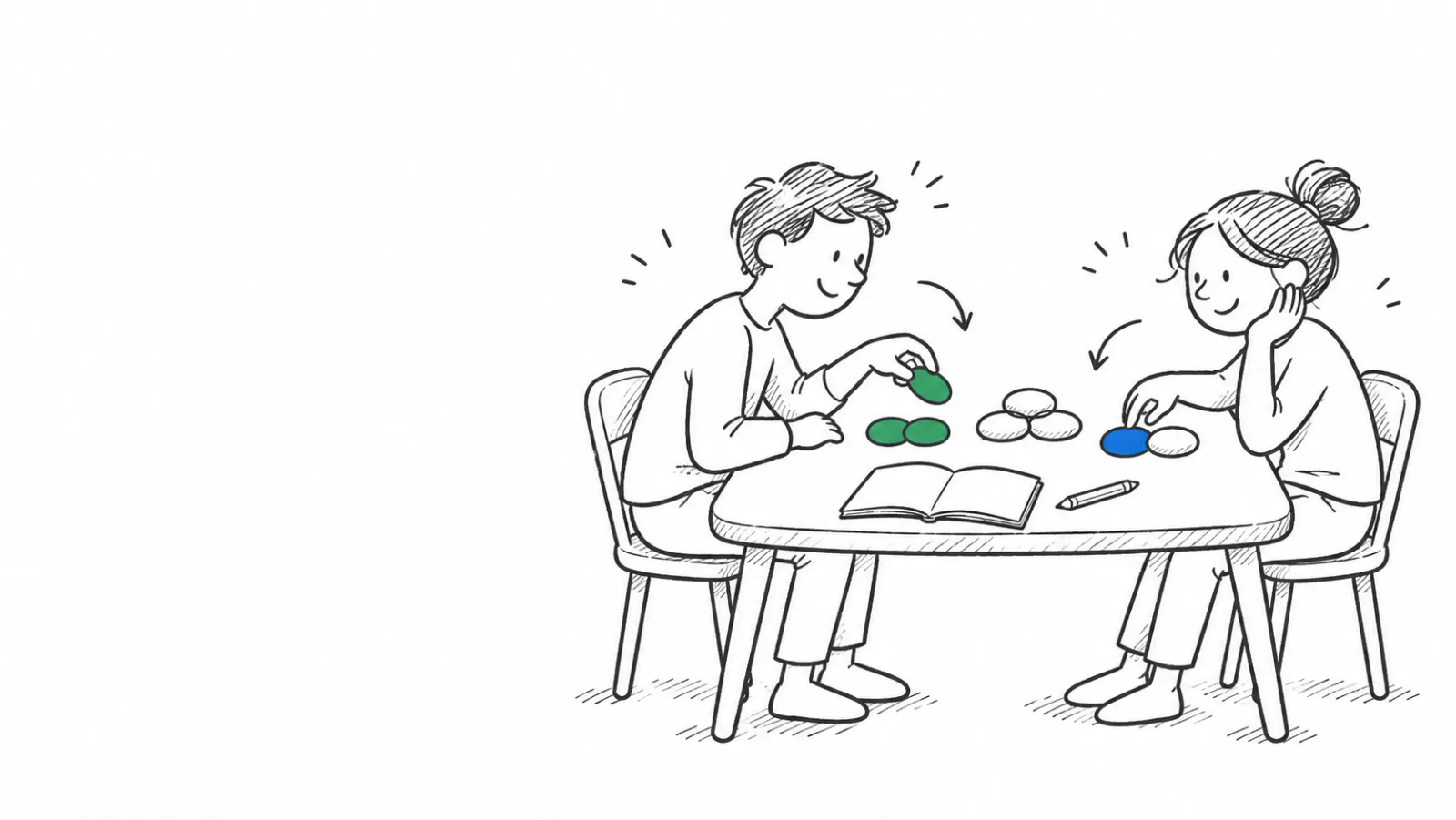

Personal values examples include honesty, freedom, family security, achievement, helping others and protecting nature. So what are personal values? They are the broad goals you use to decide what matters, at work and at home. Research by Shalom Schwartz sorts them into 10 basic values found across cultures, and what makes your values yours is the order you put them in. Two people can pick the same words and still choose differently, because one puts freedom first and the other security.
The best answer to “what are personal values examples?” is a list with structure. Below are 60 examples in those 10 groups, one meaning each, then how values sound in everyday sentences, the values most people rank highest, the values that pull against each other, and a card-sort method to find and rank your own.
What are personal values?
Schwartz defines values as “desirable, transsituational goals, varying in importance, that serve as guiding principles in people’s lives”. Put simply, a value is something you want in many situations, and it shapes how you act in each of them.
Schwartz lists six features that make a value a value:
- Values are beliefs tied to feeling. When one is activated, it comes with feeling.
- They refer to desirable goals that motivate action.
- They reach beyond any single action or situation.
- They serve as standards for judging actions, policies, people and events.
- They are ordered by importance relative to one another.
- The trade-off among competing values guides attitudes and behavior.
Values are deeply rooted motivations that “guide, justify or explain attitudes, norms, opinions and actions”. Personal core values are the few at the top of that order. Companies publish core values too, and core values covers what they list and what research says about those lists.
Schwartz derived his 10 basic values from three universal requirements: the needs of individuals as biological organisms, coordinated social interaction, and the survival and welfare of groups. Analyses of 210 samples from 67 countries support the 10 values. A 2012 refinement splits the same circle into 19 narrower values (15 samples, 10 countries, N = 6,059); this page uses the original 10, on which the lists below are built.
- basic values found across cultures
- 10
- countries in the samples that support them
- 67
- samples in the analyses that support them
- 210
Values, traits and goals
Values describe what you find important. Personality traits describe how you tend to act, think and feel. A meta-analysis of 60 studies found that the Big Five traits and Schwartz’s values relate in consistent, theoretically meaningful ways, and that the links are generally modest, which shows that traits and values are distinct. If you want the trait side, a Big Five aspects test measures it.
Goals are more specific than values: finish a degree, run a half marathon, earn a promotion. Values are the reasons behind them. Sheldon and Elliot call goals that fit your interests and core values self-concordant. People pursuing them put more sustained effort into those goals and gained more well-being when they reached them.
A list of core values: 60 examples in 10 groups
This list of core values, and of personal values more broadly, follows Schwartz’s model. Each of his 10 basic values has a defining goal and single values that represent it, and Schwartz writes that virtually all items in value lists from different cultures fall into one of the 10. That makes the 10 a sound frame for personal values examples. Most entries are Schwartz’s own items. Three come from elsewhere in his work: status from his definition of power, health from a security item and behaving properly from a conformity item in his questionnaire.
Fifteen entries come from the Personal Values Card Sort, a deck of value cards with one-line definitions. We placed these 15 into Schwartz’s groups ourselves, matching each card’s definition to a group’s defining goal: knowledge, adventure, challenge, risk, fun, leisure, comfort, mastery, hard work, fame, safety, stability, duty, simplicity and caring. Their placement is our editorial judgment, and each is marked † in the tables. Bold rows give Schwartz’s defining goal for each basic value.
The 10 values form four higher-order groups on two dimensions: openness to change against conservation, and self-enhancement against self-transcendence. Neighbors on the circle share motivations; distant values tend to conflict.
| Item | Horizontal | Vertical |
|---|---|---|
| Self-direction | Openness to change | Self-transcendence |
| Stimulation | Openness to change | Self-enhancement |
| Achievement | Openness to change | Self-enhancement |
| Power | Conservation | Self-enhancement |
| Security | Conservation | Self-enhancement |
| Tradition | Conservation | Self-transcendence |
| Benevolence | Conservation | Self-transcendence |
| Universalism | Openness to change | Self-transcendence |
Source: Schwartz, European Social Survey chapter; Schwartz, i2Insights, 2022
Openness to change: self-direction, stimulation, hedonism
Openness to change is made up of self-direction and stimulation, and partly of hedonism, and in the source’s words it “emphasises independence of thought, action, and feelings, and readiness for change”.
| Value | What it means |
|---|---|
| Self-direction | Independent thought and action: choosing, creating, exploring |
| Creativity | New ideas, done your own original way |
| Freedom | Planning and choosing your own activities |
| Independence | Making your own decisions about what you do |
| Curiosity | Exploring and understanding things for yourself |
| Choosing your own goals | Setting the direction of your life yourself |
| Knowledge | Learning and contributing valuable knowledge † |
| Stimulation | Excitement, novelty and challenge in life |
| Daring | Being willing to take a chance |
| A varied life | Doing lots of different things and welcoming surprises |
| An exciting life | A life with thrills in it |
| Adventure | Having new and exciting experiences † |
| Challenge | Taking on difficult tasks and problems † |
| Risk | Taking risks and chances † |
| Hedonism | Pleasure and sensuous gratification for oneself |
| Pleasure | Doing things that feel good |
| Enjoying life | Having a good time |
| Self-indulgence | “Spoiling” yourself now and then |
| Fun | Playing and having fun † |
| Leisure | Taking time to relax and enjoy † |
| Comfort | Having a pleasant and comfortable life † |
Hedonism shares elements of both openness to change and self-enhancement, so it also borders the next group.
Self-enhancement: achievement, power
Self-enhancement is made up of power and achievement, and partly of hedonism, and it “emphasises pursuit of one’s own interests and relative success and dominance over others”.
| Value | What it means |
|---|---|
| Achievement | Personal success through demonstrating competence according to social standards |
| Success | Doing well by the standards around you |
| Capability | Being competent and showing your abilities |
| Ambition | Aiming high |
| Influence | Having an effect on people and events |
| Mastery | Being competent in your everyday activities † |
| Hard work | Working hard and well at your life tasks (card name: industry) † |
| Power | Social status and prestige, control or dominance over people and resources |
| Social power | Having control over others |
| Authority | Being in charge and telling others what to do |
| Wealth | Having money and expensive things |
| Public image | Protecting how others see you |
| Status | Social standing and prestige |
| Fame | Being known and recognized † |
Conservation: security, conformity, tradition
Conservation is made up of security, conformity and tradition, and it “emphasises order, self-restriction, preservation of the past, and resistance to change”.
| Value | What it means |
|---|---|
| Security | Safety, harmony and stability of society, of relationships and of self |
| Family security | Keeping the people you love safe |
| Social order | A stable, orderly society |
| Reciprocation of favors | Returning favors |
| Health | Staying healthy and avoiding illness |
| Safety | Being safe and secure † |
| Stability | Having a life that stays fairly consistent † |
| Conformity | Restraint of actions, inclinations and impulses likely to upset or harm others and violate social expectations or norms |
| Politeness | Being courteous to people |
| Obedience | Doing what you are told and following rules |
| Self-discipline | Holding back impulses that could upset or harm others |
| Honoring parents and elders | Respecting older generations |
| Behaving properly | Avoiding anything people would say is wrong |
| Duty | Carrying out your duties and obligations † |
| Tradition | Respect, commitment and acceptance of the customs and ideas that traditional culture or religion provide |
| Humility | Being modest about yourself |
| Accepting your portion in life | Being satisfied with what you have |
| Devoutness | Living by a religious faith |
| Respect for tradition | Keeping the customs handed down to you |
| Moderation | Avoiding extremes in feeling and action |
| Simplicity | Living simply, with minimal needs † |
Self-transcendence: benevolence, universalism
Self-transcendence is made up of universalism and benevolence, and it “emphasises concern for the welfare and interests of others”.
| Value | What it means |
|---|---|
| Benevolence | Preservation and enhancement of the welfare of people with whom one is in frequent personal contact |
| Helpfulness | Helping the people around you |
| Honesty | Being truthful with the people close to you |
| Forgiveness | Being willing to pardon the people close to you |
| Loyalty | Standing by your friends |
| Responsibility | Being someone others can rely on |
| Caring | Taking care of others † |
| Universalism | Understanding, appreciation, tolerance and protection for the welfare of all people and for nature |
| Broadmindedness | Trying to understand people who differ from you |
| Wisdom | A mature understanding of life |
| Social justice | Fair treatment for everyone in society |
| Equality | Equal treatment for every person in the world |
| A world at peace | Freedom from war and conflict |
| Protecting the environment | Looking after nature |
To see where these 10 fall for you, the personal values test gives a ranked result for all 10, built on Schwartz’s model and the questionnaires described below.
Core values examples in everyday sentences
Core values examples are easiest to recognize as sentences about what a person wants, which is how the Portrait Values Questionnaire works. Each item is a short portrait of a person’s goals, aspirations or wishes that points to one basic value. You answer “How much like you is this person?” on six answer options, from “very much like me” to “not like me at all”. The version Schwartz proposed for the European Social Survey has 21 items, about two per value.
The sentences below are adapted from those ESS items into the second person; the official items describe “him” or “her.”
| Value | What it sounds like |
|---|---|
| Self-direction | Thinking up new ideas and being creative is important to you. You like to do things in your own original way. |
| Stimulation | You like surprises and are always looking for new things to do. |
| Hedonism | You seek every chance you can to have fun. |
| Achievement | Being very successful is important to you. You like to impress other people. |
| Power | You want to have a lot of money and expensive things. |
| Security | It is important to you to live in secure surroundings. |
| Conformity | It is important to you always to behave properly. |
| Tradition | You think it is important to be satisfied with what you have. |
| Benevolence | It is very important to you to help the people around you. |
| Universalism | You want justice for everybody, even for people you don’t know. |
Every sentence names a goal, something a person wants to have, keep or bring about, which is why they work as core values examples. A word such as “freedom” can mean many things; a sentence about choosing your own activities pins it down. If a sentence makes you think “that is me,” its value probably ranks high for you.
Which values do most people rank highest?
People and groups differ in their value priorities, and beneath those differences there is wide agreement on the order. Schwartz and Bardi compared average value rankings in representative or near representative samples from 13 nations, then in school teachers from 56 nations and college students from 54 nations. The pattern repeated: benevolence, self-direction and universalism were consistently most important; power, tradition and stimulation least important; and security, conformity, achievement and hedonism in between.
| Rank | Item | Note |
|---|---|---|
| 1 | Benevolence, self-direction, universalism | consistently most important |
| 2 | Security, conformity, achievement, hedonism | in between |
| 3 | Power, tradition, stimulation | least important |
Source: Schwartz and Bardi, Journal of Cross-Cultural Psychology, 2001
The agreement is strong. The value rankings of 83% of samples correlated at least .80 with this shared order. The closest research answer to “what are the top 10 personal values?” is this shared order of the 10 basic values, in three tiers.
Schwartz and Bardi show that reading a group’s value hierarchy correctly requires comparing it with this shared baseline, and the same logic helps with a personal list. Benevolence near the top is typical, so it says less about you than power or tradition near the top, which most people place low.
Rankings are also fairly steady. In a national probability sample of 3,962 adults aged 25 to 75, followed over 3 years, value priorities were highly stable, with one exception: among women, conservation values peaked in stability at age 50 and decreased afterward. Older adults and women placed more weight on self-transcendence and conservation values, and younger people and men on self-enhancement and openness to change.
Values that pull against each other
Schwartz arranges the 10 values on a circle because actions that serve one value have consequences for others. Seeking success for yourself can get in the way of helping people who need you, so achievement can conflict with benevolence. Achievement sits comfortably with power. The pursuit of novelty tends to undermine time-honored customs, so stimulation pulls against tradition, while tradition and conformity work together because both motivate going along with outside expectations. Conflicts such as power against universalism and tradition against hedonism appear in nearly every culture studied.
| Pair | How they relate |
|---|---|
| Achievement and benevolence | Conflict: success for yourself can get in the way of helping others |
| Stimulation and tradition | Conflict: novelty works against time-honored customs |
| Power and universalism | Conflict found in nearly every culture studied |
| Tradition and hedonism | Conflict found in nearly every culture studied |
| Achievement and power | Compatible: both serve self-enhancement |
| Tradition and conformity | Compatible: both motivate going along with outside expectations |
Schwartz puts the practical point in one line: “people can and do pursue competing values, but not in a single act”. You can care about security and about adventure. A given decision, though, will usually serve one more than the other.
This is where a ranked list earns its keep. Look up which group each of your top five belongs to, then find those groups on the quadrant above (hedonism and conformity are named in its caption). If two sit on opposite sides, expect trade-offs and decide in advance which one wins in which part of your life. A career switch may serve self-direction and stimulation while it strains security for a year or two; knowing that ahead of time lets you plan for it, for example by building savings before you move.
How to find your core values
“What are my values?” and “what are my core values?” are questions you can answer with a simple sorting task, because sorting forces you to decide. The Personal Values Card Sort, developed at the University of New Mexico, is one such procedure. To determine your core values with it, you sort value cards into five piles from least important to most important, add your own values on blank cards, and then rank the cards in the top pile from first to last. You can run the same steps with the 60 values above written on index cards or sticky notes.
- Gather candidates
Start from the list above and add any value you miss on a blank card.
- Sort into five piles
From least important to most important. Every card goes somewhere.
- Cap the top pile
Keep only the cards you would defend in the most important pile. Move the rest down.
- Rank the top pile
Put your number one value first, then the next, until every card in the pile has a place.
- Write about your top value
A few lines on why it matters and when you last acted on it.
- Check your goals
For each current goal, name the value it serves. Rewrite or drop goals that serve none.
The card sort’s one firm rule is that the most important pile holds no more than 10 cards, and ranking that pile is a separate second task. The cap is what makes the exercise work: when you identify your core values this way, you have to give some cards up. Your five most important personal values are the top five cards of that ranked pile.
Two research-backed habits turn the ranking into something you use. First, write about your top value. Self-affirmation interventions typically have people write about core personal values, and timely affirmations have improved education, health and relationship outcomes, with benefits that sometimes lasted months or years. Second, check your goals against your values. People who pursued goals consistent with their core values put in more sustained effort, were more likely to reach them, and gained more well-being when they did, a pattern that held in three longitudinal data sets. When you have your list, you can turn it into goals with a personal development plan.
If you would like a second view on “what are my personal values?”, a questionnaire can complement the card sort. For a scored ranking of all 10, the values assessment gives ranked results and a PDF report.
Why ranking beats rating
People differ in how they use rating scales: some mark nearly everything high, others hold back. Schwartz treats these individual differences in mean response level as something to remove before comparing people. For a psychometrician, that makes raw ratings a weak way to tell people apart.
Schwartz’s reason follows from his theory. Because trade-offs between values drive behavior and attitudes, “it is the relative importance of the ten values to an individual that should be measured”. Scores from his questionnaires are therefore corrected for each person’s general response level. The most common correction treats each person’s mean response across all items as a covariate in analyses; an alternative centers each person’s answers on their own mean. A meta-analysis on traits and values reached the same practical conclusion and advised controlling for personal scale-use tendencies.
Ranking builds the comparison in from the start. The older Rokeach survey asked people to rank two sets of 18 abstract values from most to least important. The relative order of the 10 values also holds up across tools: in one comparison Schwartz reports, the importance means of the 10 values from his rating survey and from the portrait questionnaire correlated at r = .95.
The takeaway for your own list is simple: force an order, even when it feels uncomfortable. The card sort’s limit of 10 cards in the top pile forces the same choice.
Do your values predict what you do?
Values are self-reported, so do they matter for action? A review in Nature Human Behaviour concludes that self-reported values predict a wide range of attitudes, preferences and overt behaviors, and that people act in ways that let them express their important values and reach the goals behind them.
The strength of the link differs by value. Across three studies of common, everyday behaviors, Bardi and Schwartz found these tiers:
| Link to behavior | Values |
|---|---|
| Strong | Stimulation, tradition |
| Moderate | Hedonism, power, universalism, self-direction |
| Marginal | Security, conformity, achievement, benevolence |
The authors suggest that the weaker links may stem from normative pressure to perform certain behaviors: values motivate behavior, and norms partly hide the relation. When nearly everyone is expected to act safely or helpfully, those acts reveal less about any one person’s values.
For your own list, this means a strong pull toward novelty or toward tradition is the kind of value most likely to show in what you actually do. Systematic study of values took hold in mainstream psychology only in the 1990s, so this evidence is younger than the everyday talk about values.
Personal values at work
Work is a common place for value trade-offs: pay against meaning, autonomy against stability, ambition against time with family. A work lens makes those trade-offs concrete.
The work values test covers six work values: achievement, independence, recognition, relationships, support and working conditions. It builds on the O*NET work values framework developed with the U.S. Department of Labor. Culture preferences are a related layer. The tech culture assessment contrasts work environments such as mission-driven, structured and traditional, and open and flexible.
Your personal ranking and your work values should line up in places. A high rank for self-direction maps naturally onto independence at work, and a high rank for security onto stable working conditions. Where they do not line up, for example a top value of benevolence in a role that rewards only individual results, you have found a likely source of friction. That is useful information before a job search, a promotion decision or a conversation with your manager about how your work is set up.
What are examples of personal values and core values?
Common personal values examples are honesty, freedom, family security, achievement, helpfulness, curiosity, respect for tradition and protecting the environment. In Schwartz's model each one belongs to one of 10 basic values: honesty to benevolence, for example, and protecting the environment to universalism. The list above gives 60 examples sorted into those 10 groups, with one meaning each.
How many core values should you have?
Research gives no fixed number. The Personal Values Card Sort caps the most important pile at 10 cards and then asks you to rank that pile, so a ranked top five to 10 is a practical working size. A short list is easier to use when two values pull in different directions and you need to decide which comes first.
Can your personal values change?
They can, slowly. In a national probability sample of 3,962 adults aged 25 to 75, value priorities were highly stable over 3 years, though conservation values among women became less stable after age 50. Older adults and women gave more weight to self-transcendence and conservation, and younger adults and men to self-enhancement and openness to change, which fits a picture of slow change across the life span.
Are values the same as personality traits?
They are related and distinct. Values describe the goals you find important, and traits describe how you tend to act and feel. A meta-analysis of 60 studies found consistent links between the Big Five traits and Schwartz's values, and the links were generally modest, which supports treating them as separate characteristics.
Sources
Show all 12 sources
- Schwartz, S. H. (2003). A proposal for measuring value orientations across nations (Questionnaire Development Report, chapter 7). European Social Survey. europeansocialsurvey.org
- Schwartz, S. H. (2022). Understanding values: Schwartz theory of basic values. Integration and Implementation Insights, Australian National University. i2insights.org
- Schwartz, S. H., Cieciuch, J., Vecchione, M., Davidov, E., Fischer, R., Beierlein, C., Ramos, A., Verkasalo, M., Lönnqvist, J.-E., Demirutku, K., Dirilen-Gumus, O., & Konty, M. (2012). Refining the theory of basic individual values. Journal of Personality and Social Psychology. doi.org/10.1037/a0029393
- Parks-Leduc, L., Feldman, G., & Bardi, A. (2015). Personality traits and personal values: A meta-analysis. Personality and Social Psychology Review. doi.org/10.1177/1088868314538548
- Sheldon, K. M., & Elliot, A. J. (1999). Goal striving, need satisfaction, and longitudinal well-being: The self-concordance model. Journal of Personality and Social Psychology. doi.org/10.1037/0022-3514.76.3.482
- Miller, W. R., C’de Baca, J., Matthews, D. B., & Wilbourne, P. L. (2001). Personal values card sort. University of New Mexico, Center on Alcohol, Substance use, And Addictions. casaa.unm.edu
- Schwartz, S. H., & Bardi, A. (2001). Value hierarchies across cultures: Taking a similarities perspective. Journal of Cross-Cultural Psychology. doi.org/10.1177/0022022101032003002
- Milfont, T. L., Milojev, P., & Sibley, C. G. (2016). Values stability and change in adulthood: A 3-year longitudinal study of rank-order stability and mean-level differences. Personality and Social Psychology Bulletin. doi.org/10.1177/0146167216639245
- Cohen, G. L., & Sherman, D. K. (2014). The psychology of change: Self-affirmation and social psychological intervention. Annual Review of Psychology. doi.org/10.1146/annurev-psych-010213-115137
- Sagiv, L., Roccas, S., Cieciuch, J., & Schwartz, S. H. (2017). Personal values in human life. Nature Human Behaviour. doi.org/10.1038/s41562-017-0185-3
- Bardi, A., & Schwartz, S. H. (2003). Values and behavior: Strength and structure of relations. Personality and Social Psychology Bulletin. doi.org/10.1177/0146167203254602
- Sagiv, L., & Schwartz, S. H. (2022). Personal values across cultures. Annual Review of Psychology. doi.org/10.1146/annurev-psych-020821-125100