An Enneagram wing is a neighbor of your core type: one of the two numbers beside it on the nine-point Enneagram circle. In the Riso-Hudson system taught by the Enneagram Institute, a wing is what the Institute calls the “second side” of a personality, and a Type 4 with a 5 wing is written 4w5. Research support for Enneagram wings is thin. A 2021 systematic review of 104 independent samples found a single study on wings, and that study did not back the idea.
This guide covers the notation, the names of all 18 wings, a way to work out which neighbor is yours, and what the research found, as checked in November 2026. Your wing only makes sense once you know your core type, which a short Enneagram test can suggest.
What an Enneagram wing is
The Enneagram Institute’s definition fits in one line: “One of the two types adjacent to your basic type is called your wing”. Integrative Enneagram Solutions, which publishes the iEQ9 questionnaire, describes wing traits as ones that “supplement or alter” those of the main type, so the core type stays at the center and the wing colors it. Hook and colleagues give an example in their review: a Type 6 may show traits of its two neighbors, Types 5 and 7.
Teachers split on how many wings count. The Enneagram Institute holds that both neighbors are active in everyone to some extent, and that most people lean on one of them, the dominant wing. In its words, that wing is “far more important,” while the second “always remains operative to some degree”. When the Institute writes “wing,” then, it means the dominant one. Supporters of what it calls two-wing theory believe both wings “operate more or less equally”. The 2021 review records the same split: a type’s traits can be “evenly pulled” from both wings or show up mainly through one of them.
Two neighboring ideas often get mixed in. Integrative Enneagram Solutions keeps wings and subtypes apart and defines a wing as “one of the two types next to your core type on the Enneagram circle”. Wings are also separate from the inner lines of the symbol, which connect each type to non-adjacent numbers and are covered below.
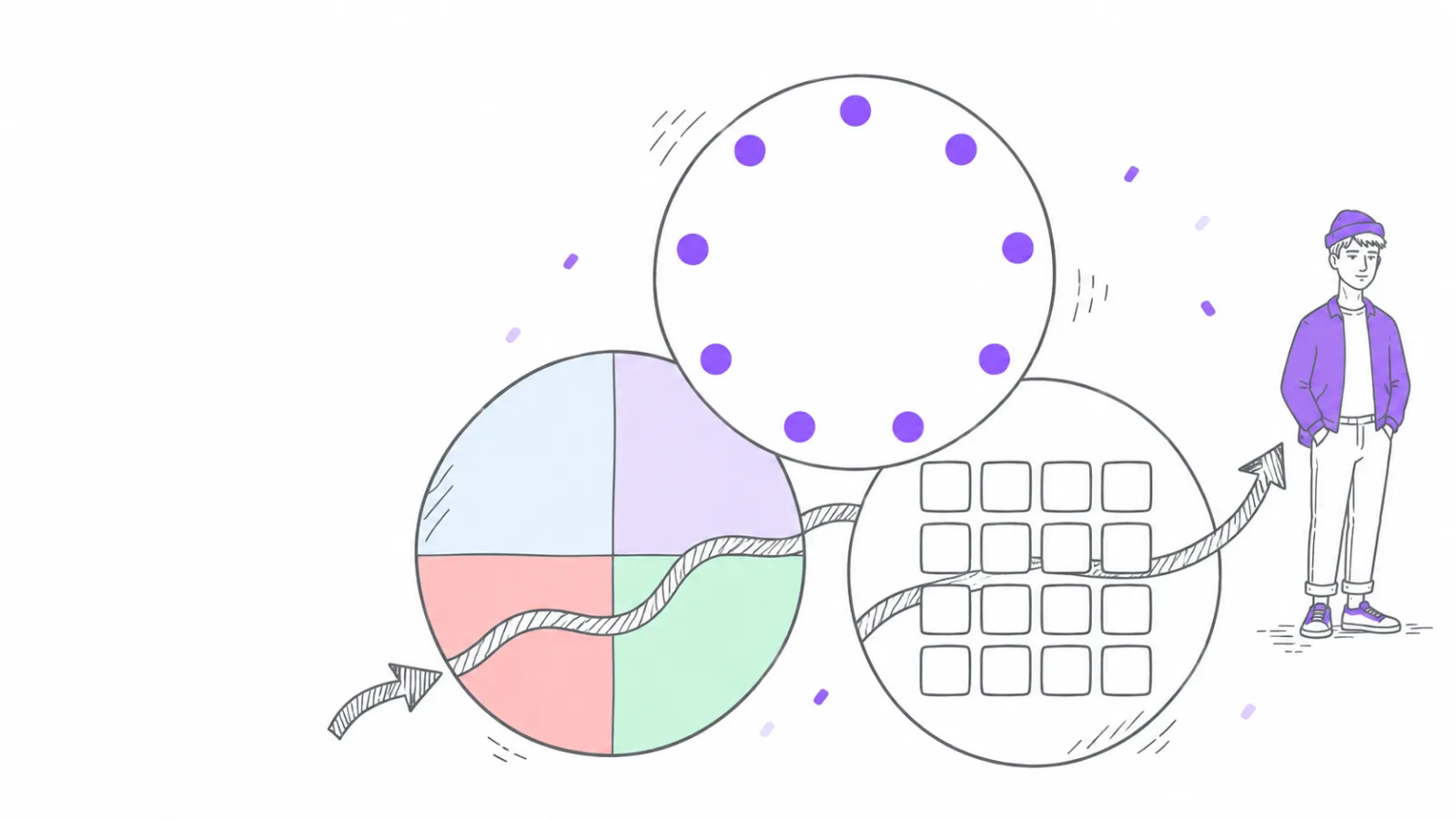
In short, a wing is a neighbor on the circle that, in the theory, lends you some of its traits. The diagram shows the two candidate wings for Type 4.
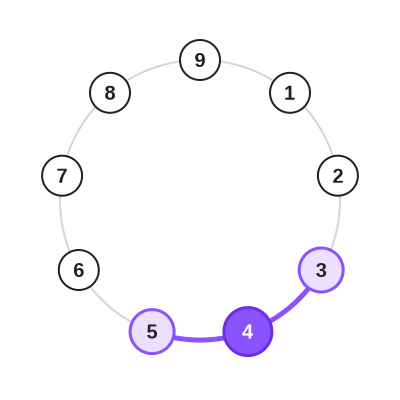
Enneagram numbers and how to read 4w5
The Enneagram Institute builds the symbol in three steps: draw a circle, space nine points evenly around it and number them, placing 9 at the top “for symmetry and by convention”. Each point is one type. Read this way, Enneagram numbers are positions on a circle. A higher number carries no rank over a lower one, and Type 9 holds the top spot only for the two reasons the Institute gives. Gyfted’s nine Enneagram type pages use the names Perfectionist through Peacemaker for Types 1 to 9.
Wing notation joins two numbers with a “w.” In the review’s example, “6w7” means a Type 6 with a 7 wing. By the same rule, 4w5 is a Type 4 with a 5 wing. The core type always comes first, and the wing second.
Because the points sit on a closed circle, neighbors wrap around the top. Type 9 sits between 8 and 1, so those are its two possible wings. Type 1 sits between 9 and 2.
The Institute also sorts the types into three centers: Instinctive (8, 9 and 1), Feeling (2, 3 and 4) and Thinking (5, 6 and 7). Hook et al. call the Thinking group the Head Triad and the Instinctive group the Body Triad. Some wings stay inside one center, such as 1w9. Others cross a boundary: 4w5 pairs a Feeling type with a Thinking neighbor.
Wings and the lines are separate ideas
The inner lines of the symbol describe movement between types. The Institute gives the direction of stress as 1-4-2-8-5-7-1 and 9-6-3-9, and the direction of growth as the reverse, 1-7-5-8-2-4-1 and 9-3-6-9. Every line joins two numbers that are not neighbors, so a line never describes a wing. Hook et al. add that Enneagram teachers disagree about this movement.
All 18 wing combinations
Nine types with two neighbors each give 18 possible wing combinations. The Enneagram Institute names every one of them on its type pages, and the table below lists those names. They are the Institute’s labels. The first column uses Gyfted’s core-type names, each linked to its type page. This is the full set of Enneagram types with wings that the theory allows, since each type has only two neighbors.
| Core type (Gyfted name) | Wing | Notation | Enneagram Institute name |
|---|---|---|---|
| 1, Perfectionist | 9 | 1w9 | The Idealist |
| 1, Perfectionist | 2 | 1w2 | The Advocate |
| 2, Helper | 1 | 2w1 | Servant |
| 2, Helper | 3 | 2w3 | The Host/Hostess |
| 3, Achiever | 2 | 3w2 | The Charmer |
| 3, Achiever | 4 | 3w4 | The Professional |
| 4, Individualist | 3 | 4w3 | The Aristocrat |
| 4, Individualist | 5 | 4w5 | The Bohemian |
| 5, Investigator | 4 | 5w4 | The Iconoclast |
| 5, Investigator | 6 | 5w6 | The Problem Solver |
| 6, Skeptic | 5 | 6w5 | The Defender |
| 6, Skeptic | 7 | 6w7 | The Buddy |
| 7, Enthusiast | 6 | 7w6 | The Entertainer |
| 7, Enthusiast | 8 | 7w8 | The Realist |
| 8, Fighter | 7 | 8w7 | The Maverick |
| 8, Fighter | 9 | 8w9 | The Bear |
| 9, Peacemaker | 8 | 9w8 | The Referee |
| 9, Peacemaker | 1 | 9w1 | The Dreamer |
The wing names read best next to the Institute’s one-line summary of each core type. Type 3 is “The Success-Oriented, Pragmatic Type”. With a 2 wing the Institute calls it “The Charmer,” and with a 4 wing “The Professional”. So 3w2 (sometimes written Enneagram 3 wing 2) and 3w4 share one core type, and the two labels mark which neighbor leans in.
Type 9, “The Easygoing, Self-Effacing Type,” shows the wrap around the top of the circle. The Enneagram 9 wings are 8, named “The Referee,” and 1, named “The Dreamer”. Type 5, “The Intense, Cerebral Type,” becomes “The Iconoclast” with a 4 wing and “The Problem Solver” with a 6 wing.
This page stops at the names. For a fuller picture, the Institute recommends reading the complete profiles of your type and of both neighbors, and the method in the next section starts there.
How to find your Enneagram wing
| Step | What happens |
|---|---|
| Find your core type | Take a test or read all nine descriptions. |
| Read both neighbors | The numbers on either side of yours. |
| Check your scores | If your test gives nine scores, is your runner-up one of the two? |
| Treat small gaps as ties | A gap of a few points is too small to call. |
| Revisit later | Some people report a second wing later in life. |
Source: Enneagram Institute; Hook et al., 2021
First, find your core type. Integrative Enneagram Solutions advises settling on a core type before exploring wings. If you are still asking “What is my Enneagram type?”, start there: read the nine type descriptions, or take a short Enneagram test and check its result against the descriptions. Gyfted’s Quick Enneagram Test “helps identify your primary personality type”, which covers this first step.
Second, read both neighbors. The Enneagram Institute suggests reading up on both neighbors and judging which sounds more like you. The table above gives your two candidates. Read them one after the other in a single sitting, so the contrast stays fresh.
Third, check your scores, if you have them. The Institute says its own questionnaire, the Riso-Hudson Enneagram Type Indicator (RHETI), “may also indicate your wing”. The original RHETI gives a total for each type’s subscale. If a test you take reports a score for each of the nine types, look at your second-highest score and ask whether it belongs to one of your two neighbors. That is the check Hook and colleagues propose as a fairer test of the wing idea itself. If your runner-up is a type across the circle, the theory has no wing label for it (the FAQ covers this case).
Fourth, treat small gaps as ties. If your two neighbors score within a few points of each other, read the result as a tie. The next two sections explain why a test score settles a close call poorly.
Fifth, revisit later. The Institute says many people report a “second wing” emerging later in life. A wing you read today can be checked again in a few years.
What research says about Enneagram wings
The fullest summary of the evidence is a systematic review published in the Journal of Clinical Psychology by Hook, Hall, Davis, Van Tongeren and Conner. Across 104 independent samples, the authors judged the evidence for the reliability and validity of Enneagram measures to be mixed. Factor analyses tended to recover fewer factors than the theory’s nine, and no study had grouped people statistically to see whether nine types emerge. For secondary parts of the theory, wings and movement between types among them, they found little supporting research.
The one study on wings
Anthony Edwards of the University of Lancaster tested the idea in 1991, in a paper titled “Clipping the wings off the enneagram”. He started from Riso’s claim that each person, on top of a basic type, carries traits of one neighboring type, the wing. If that claim holds, people reading short sketches of all nine types should judge neighboring numbers as the closest matches, and the study did not support it. Hook et al. summarize the method: participants arranged the sketches by how alike they seemed, and adjacent numbers ended up side by side no more often than chance.
Why one study leaves the question open
The reviewers count one study on wings and two on intertype movement, and they flag design flaws that make firm conclusions hard to draw. They call it “debatable” whether judging how alike written descriptions look really tests the wing idea. Their proposed test is to measure people and check whether they tend to score higher on one of their type’s two neighbors than on the other numbers. Since Edwards’s paper was the only wing study in their review, that check had not been run in the work they covered.
The plain reading has two parts. The one direct test went against wings. That test was weak, and the stronger one has yet to appear in the reviewed research. Wings remain a largely untested idea. For how the Enneagram compares with DISC and the MBTI as a measurement tool, see our guide to personality types across assessments.
| What the theory says | What research has tested | |
|---|---|---|
| Wings exist | Each type takes on traits of a neighbor | One study; adjacent types not seen as most alike |
| One dominant wing | Most people lean on one, the other stays partly active | Not tested in the reviewed studies |
| Second wing later in life | Many people report one emerging with age | No study in the 2021 review |
| Tests can show your wing | The RHETI may indicate your wing | RHETI subscale reliability is mixed |
- What the theory says
- Wings exist
- Each type takes on traits of a neighbor
- One dominant wing
- Most people lean on one, the other stays partly active
- Second wing later in life
- Many people report one emerging with age
- Tests can show your wing
- The RHETI may indicate your wing
- What research has tested
- Wings exist
- One study; adjacent types not seen as most alike
- One dominant wing
- Not tested in the reviewed studies
- Second wing later in life
- No study in the 2021 review
- Tests can show your wing
- RHETI subscale reliability is mixed
Why a wing is hard to read from a test score
The original RHETI is an ipsative, or forced-choice, test. It pairs 144 statements, adds up a score for each of the nine types, and takes the top score as the primary type. Forced-choice formats are one of several ways tests are built, and they have a real advantage: Brown and Maydeu-Olivares note that making people choose between statements can cut down on several biases that distort ordinary rating scales.
Reliability is where the trouble starts. Internal consistency, reported as alpha, shows how consistently the items of one scale agree with each other, and higher values mean more agreement. Hook et al. report that most RHETI subscales reached acceptable alphas, though some studies found low values on some of them: .35 to .84 in Dameyer (2001), .35 to .78 in Giordano (2008) and .56 to .82 in Newgent et al. (2004). Two studies of a non-ipsative version found every subscale above .70.
Hook et al. suggest that part of the difficulty comes from the forced-choice format itself. Brown and Maydeu-Olivares explain the mechanism. Scored the traditional way, forced-choice tests give every person the same total score. A profile with every scale high, or every scale low, becomes impossible, and the scales are bound to each other, which distorts profiles and reliability estimates. They also show that a different scoring model, Thurstonian item response theory, can score such tests without these problems.
For wings, the consequence is direct. On a fixed total, a point that goes to one type is a point another type cannot get. Your second-highest score is partly a product of the scoring, and a gap of a few points between your two neighbors says little about which one is your wing.
A wider question sits under the label. Haslam, Holland and Kuppens reviewed 177 taxometric articles, with 311 findings and 533,377 participants, to see whether the variables studied in personality and psychopathology behave like categories or like dimensions. Normal personality gave “little persuasive evidence” of true categories. On that reading, a wing is best treated as one more high score beside your highest. If you want your traits as scores on a continuum, a Big Five measure such as the Big Five Aspects test is built that way.
Using your wing without overreading it
A wing works well as a vocabulary for reflection. Read both neighbor descriptions side by side and note where each one fits. One may sound like you at work, the other like you with close friends or under pressure. Write down which lines rang true and which did not, so you have something concrete to compare later.
Then come back to it. Reread both descriptions in a year or two and set them next to your notes. If your sense of your wing shifts over the years, the notes make the change visible.
Keep the labels for yourself. Wing names make poor tools for sorting or judging other people, for the measurement reasons above and because a label can stick long after the evidence for it has faded. Used on yourself, a wing is a prompt to notice which neighbor you lean toward and when. That is a modest use, and it matches what the evidence can support.
Frequently asked questions
Enneagram wings explained in short answers, drawn from the Enneagram Institute, Integrative Enneagram Solutions, the 2021 systematic review and Gyfted’s test page. To find your core type before reading your wing, start with the Quick Enneagram Test.
Does everyone have an Enneagram wing?
The Enneagram Institute holds that both neighboring types are active in everyone to some extent, and that most people lean on one of them. That is a claim of the theory. Research has not tested it directly: a 2021 systematic review found a single study on wings, and the reviewers questioned its design.
Can you have both wings?
Teachers disagree. Two-wing theory holds that both wings work about equally. The Enneagram Institute holds that most people lean on one wing that matters far more, while the second stays partly active. A 2021 review describes the same split, with traits pulled evenly from both wings or showing up mainly through one. If both neighbors feel equally true, the theory allows that reading.
Can your Enneagram wing change?
The Enneagram Institute says many people report a second wing emerging later in life. That report comes from the theory itself. The only wing study in the 2021 systematic review tested how similar the types look, and none tested change, so research has no answer yet. Rereading both neighbor descriptions every few years lets you check for yourself.
Can your wing be a number that is not next to your type, like 1w3 or 9w6?
In the theory, a wing is always one of your core type's two neighbors on the circle. Type 1 has 9 and 2 as neighbors, so a 1w3 personality has no place in the system. A self-described Enneagram 9w6 may be a Type 9 pulled toward 6. The theory reads that pull through the lines, where 9 moves toward 6 under stress (9-6-3-9).
What is the rarest Enneagram wing?
No source we read, including a 2021 systematic review of Enneagram research, gives counts of how common each wing is. A real answer would need a large sample scored with a test whose wing results are reliable. Without such data, any ranking of the rarest wing is guesswork, however confidently it is stated.
Is there an Enneagram wings test?
The Enneagram Institute says its Riso-Hudson Enneagram Type Indicator "may also indicate your wing." Gyfted's Quick Enneagram Test is built to suggest your primary type, and the table of 18 wings on this page then shows your two candidates. Forced-choice tests such as the original RHETI face the scoring limits described above, so a close result between your two neighbors is best read as a tie.
Sources
Show all 8 sources
- Hook, J. N., Hall, T. W., Davis, D. E., Van Tongeren, D. R., & Conner, M. (2021). The Enneagram: A systematic review of the literature and directions for future research. Journal of Clinical Psychology, 77(4), 865-883. doi.org/10.1002/jclp.23097
- Edwards, A. C. (1991). Clipping the wings off the enneagram: A study in people’s perceptions of a ninefold personality typology. Social Behavior and Personality, 19(1), 11-20. doi.org/10.2224/sbp.1991.19.1.11
- Riso, D. R., & Hudson, R. (n.d.). How the Enneagram System Works. The Enneagram Institute. enneagraminstitute.com
- Riso, D. R., & Hudson, R. (n.d.). Enneagram Institute type descriptions, Types 1 to 9. The Enneagram Institute. enneagraminstitute.com
- Haslam, N., Holland, E., & Kuppens, P. (2012). Categories versus dimensions in personality and psychopathology: a quantitative review of taxometric research. Psychological Medicine, 42(5), 903-920. doi.org/10.1017/S0033291711001966
- Brown, A., & Maydeu-Olivares, A. (2013). How IRT can solve problems of ipsative data in forced-choice questionnaires. Psychological Methods, 18(1), 36-52. doi.org/10.1037/a0030641
- Integrative Enneagram Solutions (n.d.). Enneagram Wings Explained: How Your Wings Shape Your Type. Integrative Enneagram Solutions. integrative9.com
- Gyfted (n.d.). Quick Enneagram Test and Enneagram personality types. Gyfted. gyfted.me