
A useful list of personality traits starts with a definition. A personality trait is a stable tendency to think, feel and act in a certain way, and psychologists group the thousands of trait words in the dictionary into five broad traits, the Big Five: openness, conscientiousness, extraversion, agreeableness and neuroticism. The tables below give 104 core adjectives for the high and low end of each one, taken from a study in which expert judges agreed on the most typical words for each trait.
Around those examples of personality traits, the page covers what makes a word a trait, where the lists come from, how positive and negative traits trade off against each other, and how much traits change over a lifetime.
What are personality traits?
A personality trait is a person’s typical way of thinking, feeling and behaving. The word carries a promise of consistency. If someone scores high on extraversion, you would expect them to be sociable in most settings and to stay that way over time.
When Allport and Odbert sorted the person words in the dictionary in 1936, they placed them in four categories:
- Personality traits, such as sociable, aggressive and fearful, which they described as “consistent and stable modes of an individual’s adjustment to his environment.”
- Temporary states, moods and activities, such as afraid, rejoicing and elated.
- Evaluations of conduct and reputation, such as excellent, worthy, average and irritating.
- Physical characteristics, capacities and talents, plus words with little bearing on personality.
In this scheme, a true trait lasts and comes from inside the person. It also needs more evidence than a state. You would have to see it more often, and in more kinds of situations, before calling it part of someone’s personality.
For everyday use, this gives a simple test. A good trait word describes how someone usually is. “Stressed” describes a state that passes, and “excellent” is a verdict that leaves out what the person actually does. Fearful and afraid show how close the categories sit: the first describes a habit, the second a moment.
Traits are also dimensions, with every person somewhere along each one. Type systems sort people into categories instead, a difference our guide to personality types across assessments covers in detail.
Where lists of personality traits come from
Every list of trait words rests on the lexical hypothesis: the idea that the differences between people that matter most socially have found their way into everyday words. If people care about a difference, someone has coined a word for it.
Allport and Odbert took the idea literally. They searched the dictionary for every term that could “distinguish the behavior of one human being from that of another” and found almost 18,000 of them. Allport later called the result “a semantic nightmare,” and the two authors expected the task to keep psychologists “at work for a life time”. Cattell later worked from a smaller set of 4,500 trait terms. The figure below traces the steps from that 1936 dictionary search to the 10 aspects DeYoung and colleagues described in 2007.
| Step | What happens |
|---|---|
| Dictionary search | Allport and Odbert, 1936: almost 18,000 person words |
| Trait terms | Cattell worked from a smaller set of 4,500 trait terms |
| Five recurring factors | Tupes and Christal, 1961, then Norman, 1963 |
| Ten aspects | DeYoung and colleagues, 2007: two aspects in each trait |
Source: John, Naumann and Soto, 2008; DeYoung, Quilty and Peterson, 2007
The next step was statistics. Researchers checked which words tend to be applied to the same people, and the analyses showed that much of this vocabulary overlaps. Sociable, friendly and gregarious say much the same thing, so asking about all three adds little. One dimension can summarize them. In 1961, Tupes and Christal went back to correlation data from eight samples and found “five relatively strong and recurrent factors and nothing more of any consequence,” and Norman found the same structure again in 1963.
Goldberg picked the name Big Five to signal how broad each factor is. The structure leaves room for many narrower traits inside each factor, so five scores describe personality at its widest level and finer units add the detail.
List of personality traits by the Big Five
This personality traits list comes from a 1990 study by John, presented in John, Naumann and Soto’s 2008 chapter. Expert judges sorted 300 terms from the Adjective Check List (ACL) into the Big Five, and at least 90% of the judges put 112 of them in the same trait. Because those words turned up for the same trait study after study, they mark the narrow, “core” meaning of each factor.
The tables give the core adjectives in the order printed, which follows their factor loadings in ratings made by 10 psychologists acting as observers. Words near the top of a column are the ones most closely tied to that end of the trait. The source table prints 106 words, and two are left out here: one printed with a spelling error, and “cautious,” which the source marks with an asterisk. That leaves 104. Treat these personality traits examples as anchors. The list dates from 1990, and a few words read harshly today, so they appear exactly as printed.
Openness: curious vs conventional
People high in openness to experience go looking for new ideas, feelings, values and experiences, and enjoy them. Early researchers labeled this factor Culture and described it with words such as intellectual, polished and independent-minded. The core list still leans toward intellect. Wide interests and imaginative top the high end at .76 each, followed by intelligent and original. The public scoring keys for the Big Five Aspect Scales use the double name Openness/Intellect for the same domain.
For a self-description or a character sketch, curious, imaginative and inventive describe the high end in plain terms. The low-end words are blunt. “Simple” and “unintelligent” are how the source prints them, and in your own writing a gentler word such as conventional or practical may describe the same person more fairly.
| Low end | High end |
|---|---|
| Commonplace | Wide interests |
| narrow interests | imaginative |
| simple | intelligent |
| shallow | original |
| unintelligent | insightful |
| curious | |
| sophisticated | |
| artistic | |
| clever | |
| inventive | |
| sharp-witted | |
| ingenious | |
| witty | |
| resourceful | |
| wise |
Conscientiousness: organized vs careless
High conscientiousness shows up as care, order and hard work, along with a habit of sticking to the rules. Early researchers described this factor as orderly, responsible and dependable. In the core list, organized and thorough load highest at .80 each, with planful and efficient close behind at .78.
You can read the high end as two groups. Organized, thorough, planful and precise describe how someone handles tasks and materials. Responsible, reliable and dependable describe how someone handles promises to other people. A person can fit one group better than the other, so pick the words that match the behavior you actually see. At the low end, careless and disorderly are the strongest markers, and forgetful has the weakest loading at that end, at -.37.
| Low end | High end |
|---|---|
| Careless | Organized |
| disorderly | thorough |
| frivolous | planful |
| irresponsible | efficient |
| undependable | responsible |
| forgetful | reliable |
| dependable | |
| conscientious | |
| precise | |
| practical | |
| deliberate | |
| painstaking |
Extraversion: outgoing vs reserved
Extraverts are drawn to company, and they tend to be outgoing, active and assertive with other people. The early label was Extraversion or Surgency, with talkative, assertive and energetic as its markers. In the study behind this list, John found at least five separate strands inside the factor: activity level (active, energetic), dominance (assertive, forceful, bossy), sociability (outgoing, sociable, talkative), expressiveness (adventurous, outspoken, noisy, show-off) and positive emotionality (enthusiastic, spunky).
Those strands explain why the high end holds such different words. Bossy and show-off sit on the same side as friendly-sounding words like sociable. Talkative (.85) and quiet (-.83) are the strongest markers at each end. When you describe someone, naming the strand helps: “energetic” and “dominant” both point to high extraversion, and they paint very different people.
| Low end | High end |
|---|---|
| Quiet | Talkative |
| reserved | assertive |
| shy | active |
| silent | energetic |
| withdrawn | outgoing |
| retiring | outspoken |
| dominant | |
| forceful | |
| enthusiastic | |
| show-off | |
| sociable | |
| spunky | |
| adventurous | |
| noisy | |
| bossy |
Agreeableness: warm vs cold
Agreeable people tend to show compassion, warmth and care toward others, and they cooperate easily. People at the low end are more often rude or hostile and put their own interests first. Early researchers described the factor as good-natured, cooperative and trustful.
This is the longest column in the table, with 18 high-end words, from sympathetic at .87 down to sensitive at .51. The low-end words tie less tightly to the factor: the strongest, fault-finding, loads at -.52. The list also shows how many shades warmth has. Kind and generous describe what someone does for others, trusting and forgiving describe how they read others, and pleasant and good-natured describe how they come across. Pick the shade that matches what you have seen.
| Low end | High end |
|---|---|
| Fault-finding | Sympathetic |
| cold | kind |
| unfriendly | appreciative |
| quarrelsome | affectionate |
| hard-hearted | soft-hearted |
| unkind | warm |
| cruel | generous |
| stern | trusting |
| thankless | helpful |
| stingy | forgiving |
| pleasant | |
| good-natured | |
| friendly | |
| cooperative | |
| gentle | |
| unselfish | |
| praising | |
| sensitive |
Neuroticism: tense vs calm
Neuroticism describes how readily someone feels negative emotions such as anxiety, fear, sadness and anger, and how sensitive they are in their dealings with other people. The early label named the other end, Emotional Stability, with calm, “not neurotic” and “not easily upset” as its markers.
The table lists three words for the calm end and 14 for the tense end. Stable, calm and contented are the whole low-end column, so for the calm side you may need words of your own. Like the other four, neuroticism is a normal personality dimension. A high score describes a tendency to feel tense or moody more often, and a word from this column is a description of everyday temperament, with no medical meaning.
| Low end | High end |
|---|---|
| Stable | Tense |
| calm | anxious |
| contented | nervous |
| moody | |
| worrying | |
| touchy | |
| fearful | |
| high-strung | |
| self-pitying | |
| temperamental | |
| unstable | |
| self-punishing | |
| despondent | |
| emotional |
Each trait is a scale with two ends
Traits are continuous. Measure extraversion in a large group and most people land near the middle, with fewer and fewer toward either end. An introvert is someone toward the low end, and an extravert someone toward the high end.
| Marker | Position |
|---|---|
| Rarely social | closer to Quiet, reserved |
| Most people | at the middle |
| Very sociable | closer to Talkative, outgoing |
Source: Diener and Lucas, Noba Project; John, Naumann and Soto, 2008
The five traits, often shortened to OCEAN, are also largely unrelated to each other. Knowing how open someone is tells you little about how agreeable or how anxious they are. That is why a full trait profile takes five scores.
A single adjective works like a one-question test. You might pick “shy” on a day you felt awkward and skip it on a good day, and that noise has nothing to average against. Personality inventories ask many statements per trait.
The Big Five Aspect Scales, for example, include items such as “Get angry easily.”, “Finish what I start.” and “Like order.”. In that set, the 10-item aspect scales report alphas from .75 to .85, and three short Big Five inventories reach a mean internal consistency of .83. Alpha shows how consistently a set of items measures the same thing, and higher values mean the items agree more closely. A self-description built from adjectives is a fine starting point, and a score built from many items is the sturdier measure.
Positive and negative personality traits
Allport and Odbert gave evaluations their own category: words such as excellent, worthy and irritating judge a person’s conduct and leave unsaid which attributes prompted the judgment. Trait words carry some approval or disapproval too, which is why each table above can read like a good column and a bad column. It is easy to read lists of positive personality traits and negative personality traits that way.
Research on the Big Five points to a more balanced view. Psychologist Daniel Nettle argues that every Big Five dimension reflects a trade-off: each level brings its own evolutionary benefits and costs, so no single level is best in every environment. Work data point the same way. In two samples, the links of conscientiousness and emotional stability with job performance were curved: above a certain level, the link with performance vanished. In simpler jobs that level came earlier, which suggests that very high levels of both traits pay off more in complex work.
So the strengths and weaknesses of each Big Five trait depend on the setting. The examples below illustrate the trade-off idea. They are ways of reading the words, and no study cited here tested these particular pairs.
- Extraversion. Outgoing is easy to praise, and the same drive can turn noisy or bossy in a quiet team. Reserved is often criticized, and it can mean someone listens before they speak.
- Agreeableness. Trusting makes cooperation easier and can leave a person open to being used. Stern can feel cold, and it can also hold a line that a softer person would let slip.
- Neuroticism. Calm is admired, and very low concern can mean missing early warning signs. Worrying is unpleasant to live with, and it can also prompt someone to check a plan twice.
If you are looking for good personality traits to describe yourself or someone else, ask which level of a trait fits the situation in front of you. That keeps the words descriptive and avoids ranking people.
Beyond the Big Five: aspects, facets and a sixth trait
Inside each broad trait sit narrower traits, usually called facets. Researchers have not settled on one standard set of facets, and the well-known version by Costa and McCrae is only one of several proposals.
DeYoung, Quilty and Peterson found a level in between. They ran factor analyses on 75 facet scales from two widely used Big Five inventories, using a community sample of 481 people, and each trait split into two related but separable aspects. From that work they built the Big Five Aspect Scales (BFAS), 100 items covering the 10 aspects, and checked them in a second sample of 480 people. The scoring keys name the aspects like this:
| Big Five trait | Aspect 1 | Aspect 2 |
|---|---|---|
| Neuroticism | Volatility | Withdrawal |
| Agreeableness | Compassion | Politeness |
| Conscientiousness | Industriousness | Orderliness |
| Extraversion | Enthusiasm | Assertiveness |
| Openness/Intellect | Intellect | Openness |
Gyfted’s Big Five Aspects test has 100 questions built on the big five aspects scale model and gives feedback as soon as you finish.
A second line of research points to a sixth broad trait. Standard lexical studies in seven languages (Dutch, French, German, Hungarian, Italian, Korean and Polish) arrived at much the same six-factor structure. The HEXACO model adds Honesty-Humility. High scorers are “sincere, fair, and modest,” and low scorers “manipulative, narcissistic, and self-centered”. Anger also changes place. HEXACO Emotionality covers anxiety, vulnerability and sentimentality without anger or ill temper, which sit at the negative pole of Agreeableness. In the Big Five, anger belongs to neuroticism. The comparison below sums up the differences, which come from the six-factor studies.
| Big Five | HEXACO | |
|---|---|---|
| Broad traits | Five | Six |
| Starting point | Trait words in the dictionary | Trait-word studies in seven languages |
| Anger and ill temper | Part of neuroticism | Low end of agreeableness |
| Honesty and modesty | No separate trait | Honesty-Humility: sincere, fair, modest |
- Big Five
- Broad traits
- Five
- Starting point
- Trait words in the dictionary
- Anger and ill temper
- Part of neuroticism
- Honesty and modesty
- No separate trait
- HEXACO
- Broad traits
- Six
- Starting point
- Trait-word studies in seven languages
- Anger and ill temper
- Low end of agreeableness
- Honesty and modesty
- Honesty-Humility: sincere, fair, modest
For the tables above, a six-trait list would add a pair of columns of its own, with sincere and modest at one end and manipulative and self-centered at the other.
Do personality traits change?
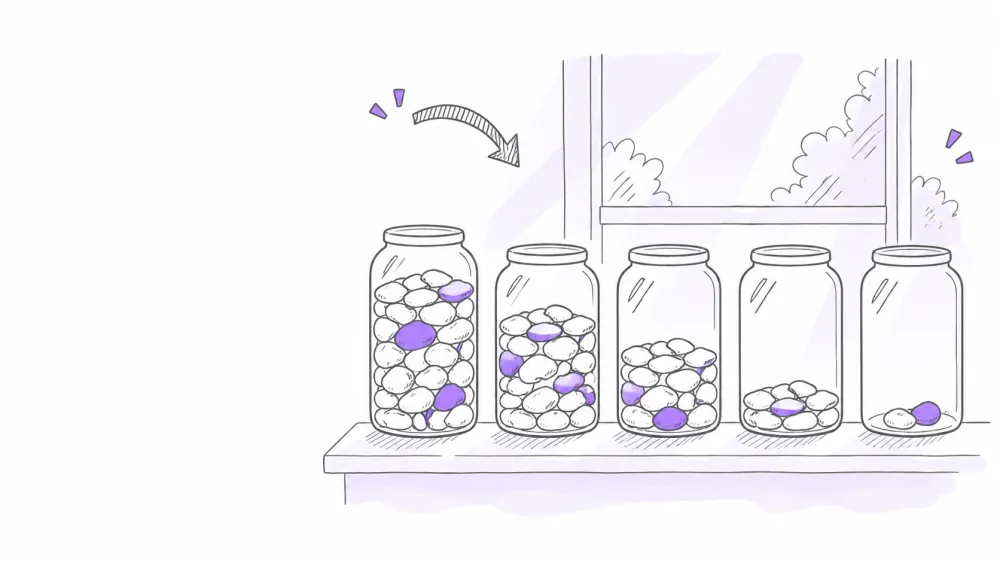
Traits are stable, and they grow more stable with age. A review of 152 longitudinal studies found that rank-order consistency rose from .31 in childhood to .54 in the college years and .64 at age 30. It then leveled off around .74 between ages 50 and 70, with the gap between measurements held at 6.7 years. Rank-order consistency asks whether people keep their place relative to others, even if everyone shifts a little.
Average levels move too. Across 92 samples, a meta-analysis found that social dominance (a facet of extraversion), conscientiousness and emotional stability go up with age, most of all in young adulthood, between ages 20 and 40. Social vitality and openness rise in adolescence and fall again in old age, and agreeableness shifted only in old age.
Change can also follow an intervention. A systematic review of 207 studies, most of them on clinical interventions, found marked changes in trait scores over an average of 24 weeks (for example, d = .37). The d statistic expresses the size of a change in standard deviation units. Emotional stability changed most, followed by extraversion. The gains also showed up in nonclinical interventions and lasted into later follow-ups. These studies mostly describe people already in some form of therapy. Read them as evidence of what change is possible.
What personality traits predict
Traits also do practical work. Trait scores help predict job performance, how long people live, and which jobs and activities they will enjoy.
These links mostly hold up when tested again. The Life Outcomes of Personality Replication Project ran preregistered replications of 78 published trait-outcome associations, with a median sample of 1,504 people. Of these, 87% came out significant and pointed the same way as the original finding. The replicated effects were typically 77% as strong as the originals, a significant drop in size.
Traits also have limits. They describe how people act on average and say much less about one person in one situation. Studies since the person-situation debate put the average effect of the situation at about the same size as the effect of traits. A conscientious person can still miss a deadline in a chaotic week.
If you want to see how your traits play out on the job, the work personality test looks at your work style. Reading and managing emotions is measured with separate tools, such as the emotional intelligence test.
How to find your own personality traits
If you are asking “what are my personality traits?”, the tables above give you words to start with. Read down each low and high column and mark the words that fit how you usually behave, across months and in different settings. Then check the list against the points below.
Before you describe yourself with trait words
- Pick words for how you usually are, across months and settings
- Leave out passing moods, such as tired or stressed
- Choose a word from each of the five traits so the picture is complete
- Add low-end words that fit you alongside the flattering ones
- Ask someone who knows you well to pick words for you as well
- For decisions that matter, use a test with many questions per trait
- Treat the result as a tendency that can shift over the years
A second view helps. The loadings behind the core word list came from observer data, in which 10 psychologists rated the people they observed. Ask a friend to mark the words they would pick for you, then compare their list with yours. Self-report and observer ratings each have strengths, which our overview of personality assessment methodologies explains. For a fuller self-portrait, the Big Five Aspects test is based on the BFAS, a 100-item measure of the 10 aspects.
Frequently asked questions
These answers draw on the studies cited above.
How many personality traits are there?
There is no single fixed number. Allport and Odbert found almost 18,000 dictionary terms that describe people. Most research summarizes these words with five broad traits, the Big Five, or with six in the HEXACO model, which adds Honesty-Humility. Each broad trait also contains two aspects and narrower facets.
What are the five main personality traits?
Openness to experience (an appetite for new ideas and experiences), conscientiousness (care, order and hard work), extraversion (sociability, energy and assertiveness), agreeableness (warmth, compassion and cooperation) and neuroticism (how readily someone feels anxiety, fear, sadness or anger). Together they are called the Big Five, or OCEAN.
What are some examples of personality traits?
From the core list: openness runs from commonplace to imaginative and curious, conscientiousness from careless to organized and reliable, extraversion from quiet and shy to talkative and assertive, agreeableness from cold and quarrelsome to sympathetic and kind, and neuroticism from calm and stable to tense and anxious. Expert judges agreed these words belong to their trait.
What are some positive personality traits?
The words that read as compliments cluster in a few columns: the high end of agreeableness (kind, warm, generous), conscientiousness (organized, reliable) and openness (curious, imaginative), plus the calm end of neuroticism. Extraversion is mixed, since outgoing sits on the same side as bossy and noisy. How well any trait serves a person depends on the setting.
Is being an introvert a personality trait?
Introversion is the low end of one trait, extraversion. Extraversion runs along a continuum: in a large group most people land near the middle, and fewer sit at either extreme. Someone called an introvert scores relatively low, so words from the core list such as quiet, reserved and shy fit them better than talkative or outgoing.
Can you change your personality traits?
Yes, slowly and on average. Long-term studies show that people tend to become more conscientious, emotionally stable and socially dominant, especially between ages 20 and 40. A review of 207 studies, mostly of clinical interventions, found marked changes in trait measures over an average of 24 weeks, mainly in emotional stability.
Sources
Show all 11 sources
- Diener, E., & Lucas, R. E. (2026). Personality Traits. Noba Project, Noba textbook series: Psychology (DEF Publishers). nobaproject.com
- John, O. P., Naumann, L. P., & Soto, C. J. (2008). Paradigm Shift to the Integrative Big Five Trait Taxonomy: History, Measurement, and Conceptual Issues. Handbook of Personality: Theory and Research, 3rd ed. (Guilford). colby.edu
- DeYoung, C. G., Quilty, L. C., & Peterson, J. B. (2007). Between facets and domains: 10 aspects of the Big Five. Journal of Personality and Social Psychology. doi.org/10.1037/0022-3514.93.5.880
- Goldberg, L. R. (n.d.). BFAS Scoring Keys: The Items in the Big Five Aspects Scales. International Personality Item Pool, Oregon Research Institute. ipip.ori.org
- Nettle, D. (2006). The evolution of personality variation in humans and other animals. American Psychologist. doi.org/10.1037/0003-066X.61.6.622
- Le, H., Oh, I.-S., Robbins, S. B., Ilies, R., Holland, E., & Westrick, P. (2011). Too much of a good thing: Curvilinear relationships between personality traits and job performance. Journal of Applied Psychology. doi.org/10.1037/a0021016
- Ashton, M. C., Lee, K., Perugini, M., Szarota, P., de Vries, R. E., Di Blas, L., Boies, K., & De Raad, B. (2004). A six-factor structure of personality-descriptive adjectives: Solutions from psycholexical studies in seven languages. Journal of Personality and Social Psychology. doi.org/10.1037/0022-3514.86.2.356
- Roberts, B. W., & DelVecchio, W. F. (2000). The rank-order consistency of personality traits from childhood to old age: A quantitative review of longitudinal studies. Psychological Bulletin. doi.org/10.1037/0033-2909.126.1.3
- Roberts, B. W., Walton, K. E., & Viechtbauer, W. (2006). Patterns of mean-level change in personality traits across the life course: A meta-analysis of longitudinal studies. Psychological Bulletin. doi.org/10.1037/0033-2909.132.1.1
- Roberts, B. W., Luo, J., Briley, D. A., Chow, P. I., Su, R., & Hill, P. L. (2017). A systematic review of personality trait change through intervention. Psychological Bulletin. doi.org/10.1037/bul0000088
- Soto, C. J. (2019). How Replicable Are Links Between Personality Traits and Consequential Life Outcomes? The Life Outcomes of Personality Replication Project. Psychological Science. doi.org/10.1177/0956797619831612