

A structured interview is a job interview in which every candidate for a role answers the same job-related questions in the same order, and interviewers score each answer against a rating scale agreed before the interviews start. A 2022 revision of the meta-analytic evidence ranked it first among common selection procedures. In those estimates, structured interviews predict job performance with a mean validity of .42, against .19 for unstructured interviews, a validity coefficient more than twice as high.
This structured interview guide covers the hiring interview. It compares structured and unstructured interviews, explains why structure works, and gives six build steps, example questions, a rating scale, scoring rules and a template.
What is a structured interview?
The U.S. Office of Personnel Management (OPM) describes a structured interview as an assessment method for job-related competencies. It asks candidates, in a planned and systematic way, how they acted in past situations, how they would act in hypothetical ones, or both. Every answer is then judged against one rating scale and one set of standards for what counts as acceptable. The aim, in OPM’s words, is that candidates have “equal opportunities to provide information and are assessed accurately and consistently”.
Google describes its own practice in plainer terms: the same questions for every candidate, answers graded on one scale, and hiring decisions based on qualifications fixed in advance. Its approach has four parts: vetted questions relevant to the role, detailed written feedback on each answer, standardized rubrics that show what poor, borderline, solid and outstanding answers look like, and interviewer training and calibration.
Campion, Palmer and Campion identified 15 components of structure: some shape what the interview asks, others how the answers are judged. When Chapman and Zweig surveyed 812 interviewees and 592 interviewers from more than 502 organizations, structure in practice came down to four dimensions: questioning consistency, evaluation standardization, question sophistication and rapport building.
A 2014 review of 20 years of studies on structure covered eight main topics, among them reducing bias, question types, rating scales, probing and reactions to structure. From a measurement point of view, a structured interview is a test given out loud, and its structure is what lets two interviewers give the same answer the same score.
Structured vs unstructured interview
OPM draws the line between the two formats in three places. In a structured interview, all candidates hear the same questions in the same order, while in an unstructured one they may be asked different questions. A structured interview rates everyone on a common scale; an unstructured interview needs no standardized scale. In a structured interview, interviewers agree on what an acceptable answer looks like, and in an unstructured one they do not have to.
The unstructured interview has real appeal, and OPM names it: a loose framework, content left to the interviewer’s discretion and the flow of a conversation. The guide argues that this freedom is the problem: judgments become subjective, less accurate and harder to defend in court. It adds that unstructured interviews typically show low reliability, meaning interviewers’ ratings of the same candidate disagree, and low to moderate validity.
That openness can mislead. In one set of experiments, people formed impressions of an interviewee just as confidently when the answers came from a random response system as when they were real.
The gap between the formats shows up across many studies. McDaniel and colleagues pooled 245 validity coefficients from 86,311 people and found that structured interviews had higher validity than unstructured ones. The comparison below sets the two formats side by side.
| Structured | Unstructured | |
|---|---|---|
| Questions | Same job-related questions for everyone | Can differ by candidate |
| Order | Fixed | Follows the conversation |
| Follow-up probes | Listed in advance | Left to the interviewer |
| Scoring | Anchored scale for each question | No standardized scale |
| Agreement on good answers | Set before interviews | Not required |
| Mean validity | .42 | .19 |
- Structured
- Questions
- Same job-related questions for everyone
- Order
- Fixed
- Follow-up probes
- Listed in advance
- Scoring
- Anchored scale for each question
- Agreement on good answers
- Set before interviews
- Mean validity
- .42
- Unstructured
- Questions
- Can differ by candidate
- Order
- Follows the conversation
- Follow-up probes
- Left to the interviewer
- Scoring
- No standardized scale
- Agreement on good answers
- Not required
- Mean validity
- .19
Where the semi-structured interview fits
The studies cited here give no single definition of a semi-structured hiring interview. OPM’s guide describes one in-between format, the selecting official’s interview: its questions can stay the same from candidate to candidate, and the answers are usually left unscored. Huffcutt and Arthur treated structure as a matter of degree, classified on several dimensions.
Moving toward the structured end pays off for a while. In their meta-analysis of 114 validity coefficients for entry-level jobs, validity climbed as interviews gained structure, up to a point where more structure added essentially nothing. The number of interviews can partly stand in for structure. Schmidt and Zimmerman found that one structured interview with a single interviewer matched the validity of three to four independent unstructured interviews averaged together. One well-built interview takes far less time than three or four loose ones.
Why structure makes interviews more accurate
Reliability comes first: a score predicts only as well as interviewers agree on it. From a meta-analysis of 111 interrater reliability coefficients and 49 coefficient alphas, Conway, Jako and Goodman estimated upper limits of validity of .67 for highly structured interviews and .34 for unstructured ones. Those figures are ceilings set by how consistently each format is scored. Three parts of structure moderated how well interviewers agreed: standardized questions, standardized evaluation of answers and a standard way of combining several ratings.
Content comes second. Huffcutt and colleagues classified 338 ratings from 47 interview studies and found that more and less structured interviews end up measuring different things. Part of the reason structured interviews predict better, they concluded, is that they spend more time on qualities closely tied to performance.
The figures themselves were revised in 2022. Sackett, Zhang, Berry and Lievens reworked earlier meta-analyses. They had found that the older work overcorrected for restriction of range. The procedures that ranked high before mostly stayed high, with mean validity estimates lower by .10 to .20, and structured interviews came out as the top-ranked selection procedure. The authors also stressed the spread: the mean of .42 has an 80% credibility interval from .18 to .66, so it should be read as “.42, plus or minus .24”.
Across many hires, .42 means higher scorers tend to do better. For any single candidate it promises nothing, and the range shows that in some settings a structured interview predicts much less.
Structure also bears on fairness. In applicant samples, the average Black-White difference in interview scores was smaller for structured interviews (d = 0.23) than for unstructured ones (d = 0.32). The full process for reducing bias in hiring decisions covers the other steps.
Interviews also rate more than job behavior. Across interview studies, basic personality and applied social skills were the constructs rated most often. If traits matter for the role, a questionnaire built for that purpose can measure them, which leaves interview time for job behavior.
How to create a structured interview in six steps
OPM’s guide lists eight development steps, from a job analysis to documenting how the interview was built. The six steps below merge them into a structured interview process a hiring team can run itself, one role at a time. Most of how to conduct a structured interview is decided before the candidate arrives.
| Step | What happens |
|---|---|
| Analyze the job | Pick four to six competencies with people who know the role. |
| Write questions | Draft past-behavior and situational questions, more than you need. |
| Anchor the scale | Describe weak, average and strong answers for each question. |
| Fix the probes | List the follow-ups interviewers may use. |
| Pilot and train | Test with colleagues, revise, train every interviewer. |
| Run, rate, record | Same order, notes, ratings right after, a written record. |
Source: U.S. OPM 2008
1. Analyze the job and pick the competencies
Start with a job analysis that sets out what the work requires. A structured interview typically assesses four to six competencies, more only for unusual or senior roles. Choose the ones an interview measures well; OPM names oral communication and interpersonal skills as particularly suited to it. Once the competencies are written down, a role-based candidate assessment can cover the traits and abilities you decide not to interview for, before the final round.
2. Write more questions than you need
OPM suggests convening about six or seven people who know the job well, which the guide calls subject matter experts. Tie every question to a competency from the job analysis, and write it so the answer brings out the situation, what the person did or chose not to do, and what came of it. Keep questions open-ended, clear, concise and free of jargon. Draft more than you will use, so weak questions can be dropped during review and tryout. Google often opens with one question and then asks several follow-ups to understand how the candidate reasons.
3. Anchor the rating scale
Decide on one rating range for all competencies, for example 1 to 5, with 5 the most proficient. Use at least three levels and aim for five to seven, and label at least three of them, such as unsatisfactory, satisfactory and superior. Then write example answers for the levels. Google, for instance, describes answers at four levels, from poor to outstanding. Anchors pay off in agreement. In Taylor and Small’s meta-analysis, interrater reliability for past-behavior questions was .77 with descriptively anchored rating scales and slightly lower, .73, without them.
4. Fix the probes
A probe is a follow-up question that clarifies an answer or checks that the candidate has given enough information. Before the first interview, decide how much probing is allowed: none, a limited number or as many as needed. Then list the probes for each question. When interviewers probe, they should ask nearly the same follow-ups of every candidate, so each person gets the same chance to show what they can do.
5. Pilot and train
Try the questions out on colleagues before any real candidate hears them. The pilot shows whether the wording is clear and whether the questions draw a suitable range of answers. Revise, then train every interviewer. Training is often missing: fewer than 34% of interviewers in Chapman and Zweig’s survey had been formally trained to interview, and interviewers with formal training used more structure. Google’s approach includes interviewer training and calibration, with the goal that interviewers feel confident and rate consistently.
6. Run, rate and document
Ask every candidate the same questions in the same order. Take regular, detailed notes on what the candidate says and the examples they describe, so nobody relies on memory. Rate right after the candidate leaves, from the notes, and check that the notes justify each rating on each competency. Last, keep a written record of how the interview was developed, which is OPM’s final step. Candidate screening before the interview keeps the interview slots for the people who meet the basics.

Structured interview questions: examples by competency
Structured interview questions come in two kinds: past-behavior questions about what a candidate did, and situational questions about what they would do. OPM calls an interview built on past-behavior questions a behavioral description interview, and one built on hypothetical questions a situational interview.
Past-behavior or situational questions?
Past-behavior questions assume that how someone handled similar situations before is the best guide to how they will act in the job. Situational questions give a realistic job scenario or dilemma and assume that what a person intends to do is closely tied to what they end up doing.
The evidence points both ways. Taylor and Small found that with descriptively anchored rating scales, past-behavior studies averaged a validity of .63 against .47 for situational studies, with similar interrater reliability (.77 and .79). They also tested whether situational questions predict worse in complex jobs and found no evidence that they do.
An earlier meta-analysis by McDaniel and colleagues ranked situational interviews above job-related ones. Both meta-analyses predate the 2022 revision, which found that earlier work had overcorrected for restriction of range and lowered most validity estimates. Taylor and Small’s figures therefore sit higher than the revised .42 and are best compared within their own study.
The practical answer is to use both kinds and anchor both. OPM allows a mix of the two formats, and Google uses behavioral questions to see patterns in past behavior and hypothetical ones to see how a candidate handles something they have not faced yet.
A structured interview example: questions for six competencies
The questions below were written for this guide as illustrations. Adapt them after your own job analysis, and keep each one tied to a competency. Each question and its probes draw out a situation, an action and a result, as OPM’s guide recommends.
| Competency | Past-behavior question | Situational question | Standard probes |
|---|---|---|---|
| Planning and organizing | Tell me about the most complicated schedule you have had to manage. What did you plan, and what changed? | Two deadlines you own land on the same day, and both requesters say theirs comes first. What do you do in the first hour? | What did you do first? Who did you involve? What was the result? |
| Problem solving | Describe the last time results did not match what you expected. How did you find the cause? | A report you send every week suddenly shows a drop no one can explain. How do you work out what happened? | What did you check first? What did you rule out? What would you do differently? |
| Collaboration | Tell me about a time you disagreed with a colleague about how to do a piece of work. What did you do? | A teammate keeps missing handoffs your work depends on. How do you handle it? | What did you say? How did they respond? How did it end? |
| Communication | Describe a time you had to explain a decision to people who disagreed with it. | You have to tell a client that a delivery will be late. How do you prepare and what do you say? | Who was the audience? What did you adapt? How did you know it worked? |
| Customer focus | Describe the most difficult customer situation you have handled. What did you do? | An upset customer says they were promised a refund that never arrived. How do you respond? | What did the customer need? What did you do next? What was the outcome? |
| Leading others (manager roles) | Tell me about the last time you addressed a performance problem on your team. | A strong performer asks to move teams in the middle of a critical project. What do you do? | What did you consider? What did you decide? What happened afterward? |
Questions about culture fit need the same treatment: a defined competency, fixed questions and an anchored scale. Our guide to interview questions that assess culture fit covers that ground. For manager roles, add the leading-others row and consider a trait assessment built for managers alongside it.
How to score a structured interview
Scoring turns answers into a measurement. Two decisions matter: what the scale says at each level, and how several ratings become one score.
An example rating scale
OPM’s own example rates interpersonal skills on five levels, with 1, 3 and 5 labeled low, average and outstanding. Each labeled level is defined by how much tension the situations the candidate handled involved, from little or none up to a high degree. Google writes sample answers at the same four levels for every quality a question is meant to test.
The scale below applies the same idea to the collaboration past-behavior question from the table: five levels, three of them labeled, as OPM advises. Treat it as a structured interview example and rewrite the anchors with your own subject matter experts. Use this scale as a template for your other questions.
| Rating | What the answer shows |
|---|---|
| 1 (weak) | Talks about the disagreement in general terms, blames the colleague, and gives no action or outcome. |
| 2 | Names a real disagreement but describes little of what they did. |
| 3 (solid) | Describes a specific disagreement, raised it directly with the colleague, and reached a workable outcome. |
| 4 | As 3, and explains how they understood the colleague’s view before proposing a fix. |
| 5 (outstanding) | Specific situation; asked for the colleague’s reasons first; proposed options tied to the shared goal; states the outcome and what they would repeat or change. |
Panels, independent ratings and combining scores
Huffcutt, Culbertson and Weyhrauch analyzed 125 reliability coefficients with a total sample of 32,428. Their estimates count all three sources of measurement error. Mean interrater reliability was .74 for panel interviews, where interviewers rate the same conversation, against .44 when different interviewers each held their own interview. The authors also noted that highly structured interviews held one-on-one by different people agreed less than expected. So use a panel where you can, and when feasible keep the same interviewers across all candidates, either as a panel or one after another.
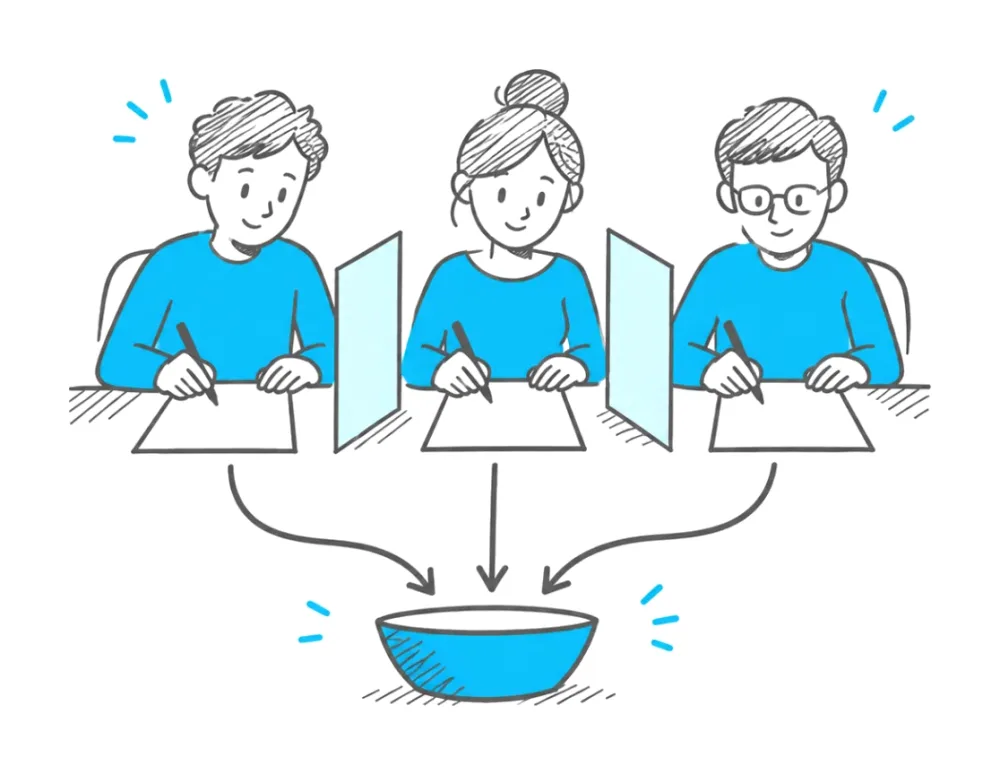
Keep the ratings independent. In a panel, each member should observe, record and evaluate the answers individually. How the ratings are combined matters too. In Conway and colleagues’ meta-analysis, combining several ratings by formula helped, and combining them by judgment showed no benefit.
OPM’s panels talk through their individual ratings after each candidate and settle on final scores together. Given Conway’s finding, a safer version keeps each person’s independent ratings on file and sets an averaging rule before the first interview. Discussion can then correct errors of fact, such as a misheard answer, and the final number still comes from the rule.
Interview scores often meet test scores in the final decision, where the same rule-based logic applies; our review of pre-employment personality tests covers the testing side.
Why many teams still skip structure
Why do so many interviews stay loose? In a study of 79 human resources managers, intentions favored unstructured over structured interviews, matching how the managers already hired. Their attitudes, and what they believed others expected of them, predicted those intentions.
Highhouse describes two implicit beliefs behind the resistance. The first is that near-perfect prediction of job performance is possible in principle, so selection is not seen as probabilistic and prone to error. The second is that experience improves the prediction of behavior. He calls this the myth of expertise, and it leads people to lean on intuition and avoid decision aids that might undercut their credibility. Interviewers in Chapman and Zweig’s survey were confident they could spot the strongest candidate however structured the interview was.
Some costs are real, and Google names them: someone has to write and test the rubrics, interviewers must keep to them, and the questions need regular replacing so candidates cannot share answers.
Applicants in Chapman and Zweig’s study saw structured interviews as harder and disliked that, yet structure made no difference to whether they judged the procedure fair. Google reports two results from its own surveys. In Google’s words, rejected candidates “who had a structured interview were 35% happier than those who did not have a structured interview.” Interviewers also saved 40 minutes per interview on average by working from ready-made questions and rubrics. Both figures are company-reported and have not been peer reviewed.
Structured interview template
The checklist condenses the six steps into one page for a hiring round. Pair it with the question table and the rating scale above, and fill in the details for the role you are hiring for. Each item is one piece of structure; a box left empty means the interview is less structured than it looks, and its ratings will be harder to compare across candidates.
Use one copy per role. Write the competencies at the top, attach the questions, probes and anchors, and keep the completed sheet with the interview notes, since OPM’s last step is a written record of how the interview was developed. When a new interviewer joins the panel, the same sheet works as a briefing: it shows what is asked, how answers are rated and how the scores are combined.
Structured interview template
- Four to six competencies from a job analysis, written down
- Every question linked to a competency
- Past-behavior and situational questions both considered
- An anchored rating scale for each question
- Standard probes listed for each question
- A pilot run with colleagues
- Every interviewer trained
- The same questions in the same order for every candidate
- Each interviewer rates alone, right after the interview
- Ratings combined by a rule set in advance, with notes kept for each rating
Questions about structured interviews
These answers draw on the guidance and studies cited above.
What is the difference between a structured and a semi-structured interview?
A structured interview fixes the questions, their order, the probes and an anchored rating scale for every candidate. The studies cited here give no single definition of the semi-structured format. OPM describes an in-between interview with consistent questions and usually no scoring. Validity rises as structure is added, up to a point where more adds little.
Can you give an example of a structured interview question?
For interpersonal skills, adapted from OPM's example: Tell me about a time you worked with someone who was upset or hostile. What was going on, what did you do, and how did it end? Standard probes: Who else was there? What exactly did you say? What happened next? Every candidate hears the same question and probes, and each answer is rated on the same anchored scale.
How many questions should a structured interview have?
Start from the competencies. OPM's guide says a structured interview typically assesses four to six of them, more only for unusual or senior roles. Write at least one question per competency, often one past-behavior and one situational, and draft extra questions so the weakest can be dropped after the pilot. Leave time for the standard probes on each question.
Do candidates like structured interviews?
The evidence is mixed. In a large field survey, applicants found structured interviews harder and reacted negatively to that, yet their sense of fair procedure did not change. Google reports, from its own surveys, that rejected candidates were happier after a structured interview than those who had none. That result is company-reported and has not been peer reviewed.
Are structured interviews legally safer?
Structure tends to help. In a study of 130 US federal court claims, objective, job-related content and standardized administration were the aspects of structure most strongly linked to verdicts for employers. OPM notes that hiring interviews face the same legal requirements as written tests. Those cases are decades old and laws vary by place, so check your process with employment counsel.
Sources
Show all 18 sources
- U.S. Office of Personnel Management (2008). Structured Interviews: A Practical Guide. U.S. Office of Personnel Management. opm.gov
- Sackett, P. R., Zhang, C., Berry, C. M., and Lievens, F. (2022). Revisiting meta-analytic estimates of validity in personnel selection: Addressing systematic overcorrection for restriction of range. Journal of Applied Psychology, 107(11), 2040-2068. doi.org/10.1037/apl0000994
- Sackett, P. R., Zhang, C., Berry, C. M., and Lievens, F. (2023). Revisiting the design of selection systems in light of new findings regarding the validity of widely used predictors. Industrial and Organizational Psychology, 16(3), 283-300. doi.org/10.1017/iop.2023.24
- The re:Work Editorial Team (2026). A guide to structured interviewing for better hiring practices. Google re:Work. rework.withgoogle.com
- Campion, M. A., Palmer, D. K., and Campion, J. E. (1997). A review of structure in the selection interview. Personnel Psychology, 50(3), 655-702. doi.org/10.1111/j.1744-6570.1997.tb00709.x
- Chapman, D. S., and Zweig, D. I. (2005). Developing a nomological network for interview structure: Antecedents and consequences of the structured selection interview. Personnel Psychology, 58(3), 673-702. doi.org/10.1111/j.1744-6570.2005.00516.x
- Levashina, J., Hartwell, C. J., Morgeson, F. P., and Campion, M. A. (2014). The structured employment interview: Narrative and quantitative review of the research literature. Personnel Psychology, 67(1), 241-293. doi.org/10.1111/peps.12052
- Dana, J., Dawes, R., and Peterson, N. (2013). Belief in the unstructured interview: The persistence of an illusion. Judgment and Decision Making, 8(5), 512-520. journal.sjdm.org
- McDaniel, M. A., Whetzel, D. L., Schmidt, F. L., and Maurer, S. D. (1994). The validity of employment interviews: A comprehensive review and meta-analysis. Journal of Applied Psychology, 79(4), 599-616. doi.org/10.1037/0021-9010.79.4.599
- Huffcutt, A. I., and Arthur, W., Jr. (1994). Hunter and Hunter (1984) revisited: Interview validity for entry-level jobs. Journal of Applied Psychology, 79(2), 184-190. doi.org/10.1037/0021-9010.79.2.184
- Schmidt, F. L., and Zimmerman, R. D. (2004). A counterintuitive hypothesis about employment interview validity and some supporting evidence. Journal of Applied Psychology, 89(3), 553-561. doi.org/10.1037/0021-9010.89.3.553
- Conway, J. M., Jako, R. A., and Goodman, D. F. (1995). A meta-analysis of interrater and internal consistency reliability of selection interviews. Journal of Applied Psychology, 80(5), 565-579. doi.org/10.1037/0021-9010.80.5.565
- Huffcutt, A. I., Conway, J. M., Roth, P. L., and Stone, N. J. (2001). Identification and meta-analytic assessment of psychological constructs measured in employment interviews. Journal of Applied Psychology, 86(5), 897-913. doi.org/10.1037/0021-9010.86.5.897
- Taylor, P. J., and Small, B. (2002). Asking applicants what they would do versus what they did do: A meta-analytic comparison of situational and past behaviour employment interview questions. Journal of Occupational and Organizational Psychology, 75(3), 277-294. doi.org/10.1348/096317902320369712
- Huffcutt, A. I., Culbertson, S. S., and Weyhrauch, W. S. (2013). Employment interview reliability: New meta-analytic estimates by structure and format. International Journal of Selection and Assessment, 21(3), 264-276. doi.org/10.1111/ijsa.12036
- van der Zee, K. I., Bakker, A. B., and Bakker, P. (2002). Why are structured interviews so rarely used in personnel selection? Journal of Applied Psychology, 87(1), 176-184. doi.org/10.1037/0021-9010.87.1.176
- Highhouse, S. (2008). Stubborn reliance on intuition and subjectivity in employee selection. Industrial and Organizational Psychology, 1(3), 333-342. doi.org/10.1111/j.1754-9434.2008.00058.x
- Williamson, L. G., Campion, J. E., Malos, S. B., Roehling, M. V., and Campion, M. A. (1997). Employment interview on trial: Linking interview structure with litigation outcomes. Journal of Applied Psychology, 82(6), 900-912. doi.org/10.1037/0021-9010.82.6.900